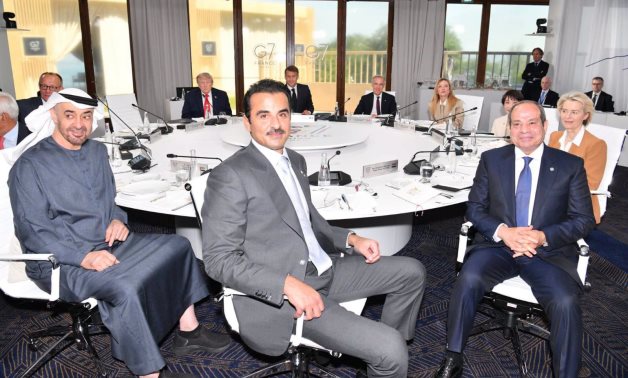




CAIRO – 16 June 2026: President Abdel Fattah El-Sisi participated on Tuesday in a session titled “Exiting Crises and Ensuring Stability in the Middle East” in Evian, France, held on the sidelines of the G7 Summit.
The session was attended by the leaders of the G7 member states, Sheikh Mohamed bin Zayed Al Nahyan, President of the United Arab Emirates; Sheikh Tamim bin Hamad Al Thani, Emir of Qatar; as well as the President of the European Council and the President of the European Commission.
The official spokesperson for the Presidency stated that President El-Sisi reviewed Egypt’s vision regarding developments in regional issues, emphasizing the need to reach comprehensive settlements to the geopolitical crises facing the Middle East in order to ensure regional and global peace and stability, particularly in light of the suffering caused by years of wars and conflicts.
El-Sisi stressed that there is no alternative to achieving a just and lasting settlement to the Palestinian issue based on the two-state solution, guaranteeing the establishment of an independent Palestinian state along the June 4, 1967 borders, with East Jerusalem as its capital.
The President also emphasized the need to expedite the implementation of US President Donald Trump’s peace plan for the Gaza Strip.
He expressed appreciation for President Trump’s efforts, which led to the agreement to end the war in Gaza and, more recently, to the agreement to end the conflict with Iran. El-Sisi affirmed Egypt’s readiness to exert every effort, in cooperation with regional and international partners, to achieve sustainable solutions to outstanding regional issues.
He also reiterated Egypt’s complete rejection and condemnation of the unjustified attacks on the Gulf Arab states and affirmed Egypt’s full solidarity with and support for those states in preserving their security and stability. He stressed that the security of Arab states is an integral part of Egypt’s national security.
In the same context, the President noted that, amid the focus on the crisis with Iran, the scope of the “yellow line” in the Gaza Strip had expanded to encompass approximately 70% of the territory, effectively leaving only 30% available to the Palestinian population.
He added that this approach must cease immediately and that the annexation of the West Bank must not be permitted.
The official spokesperson stated that the President also affirmed that achieving stability in the region requires all parties to adopt a responsible approach based on respect for state sovereignty, rejection of aggression and interference in the internal affairs of states, an end to occupation, adherence to international law, preservation of national institutions, and the restriction of weapons to legitimate state institutions.
He stressed the importance of agreeing on regional arrangements for collective security that take into account the concerns of all parties, as well as adhering to international legal principles governing the management of transboundary resources, particularly those related to water security, energy security, and the security of maritime routes.
The President also emphasized the need to establish a Middle East zone free of nuclear weapons and other weapons of mass destruction, as well as the comprehensive and non-selective implementation of the nuclear non-proliferation regime throughout the region to preserve peace and stability.
The spokesperson added that the President addressed freedom of navigation, stressing the need to guarantee the freedom and safety of navigation in international waterways in accordance with international law and rejecting any obstruction of navigation or attempts to alter its legal status.
The session also addressed the need to prevent Iran from acquiring nuclear weapons and highlighted the importance of preserving freedom of navigation and passage through international waterways.
Participants also discussed the situation in Lebanon. According to the spokesperson, several leaders criticized the policies and practices of the Israeli Prime Minister and his government in the region, particularly in Lebanon and with regard to the Palestinians.
They stressed the need for Israel to cease its attacks on Lebanon, withdraw from Lebanese territory, empower the Lebanese government, and consider the possibility of deploying an international peacekeeping force in the country.
Several participating leaders also emphasized the necessity of resolving the Palestinian issue and moving to the second phase of the Gaza ceasefire agreement, ultimately leading to the establishment of a Palestinian state alongside Israel.
The meeting further addressed energy infrastructure and highlighted the negative repercussions of regional developments on international shipping, trade, and energy supplies, underscoring the need to continue efforts to secure international maritime routes.
In this context, several leaders praised Egypt’s role and President El-Sisi’s efforts to promote stability and peace in the region.
The Italian Prime Minister noted that President El-Sisi’s participation in the meeting reaffirmed that peace can only be achieved through agreements similar to the peace treaty signed between Egypt and Israel. She also stressed the importance of reaching a just solution for the Palestinian people.
The Canadian Prime Minister likewise highlighted the significant role played by President El-Sisi and President Trump in reaching an agreement to end the war in the Gaza Strip.
At the conclusion of the meeting, President El-Sisi made additional remarks, describing the Egypt-Israel peace treaty as a model that should be emulated and stressing that the current opportunity to achieve broader regional peace must be seized.
The President also emphasized the need to prevent any attempts to undermine the agreements achieved through President Trump’s efforts, whether related to maintaining the ceasefire in the Gaza Strip or ending the conflict with Iran.
He noted that Israel’s failure to withdraw from the five positions it continues to occupy in Lebanon, despite the provisions of the ceasefire agreement, has contributed to escalating tensions. He reiterated the pivotal role played by President Trump in efforts to resolve regional crises.

Be Social




Comments
Leave a Comment