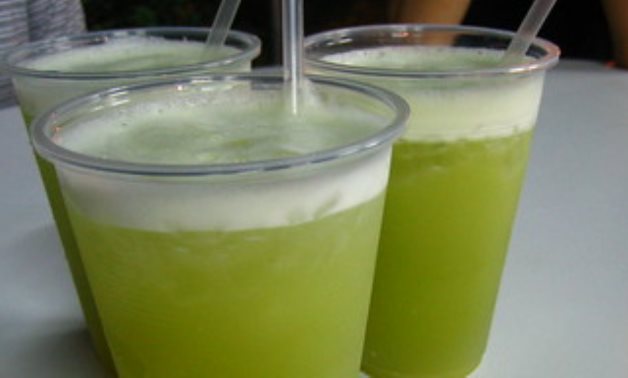
Sugarcane Juice- CC via Flickr/ER and Jenny




CAIRO – 13 June 2026: Sugarcane juice is one of the most beloved, most affordable summer refreshments for Egyptians nationwide. It is also a staple for the poor and low-income families, as its prices range from LE 10 for one small glass up to LE 25 for the large one. However, the authorities’ recent regulatory crackdowns revealed this type of juice is unhealthy as it is being whitened illicitly with a debatable coloring food additive by local vendors.
It has been revealed that most of the juice shops and sugarcane juice carts [mobile vending carts equipped with heavy juice dispensers] add titanium dioxide (TiO₂) [European food additive, code E171] in sugarcane juice. Naturally, sugarcane darkens just minutes after being exposed to air due to oxidation, so TiO₂ is used to brighten its color and persuade the customers the juice is fresh.
This was uncovered during a routine licensing inspection in the city of Toukh, Qalyubia. Authorities from the Consumer Protection Agency (CPA) confiscated contaminated sugarcane samples from several shops and carts, revealed Islam El-Gazzar in comments to Extra News.
He continued that titanium dioxide is labeled as “very dangerous” and is, hence, banned from usage in food manufacturing factories. The investigations further revealed that the vendors are totally ignorant of its danger and use it randomly and in massive quantities, which “poses main risks to the kidney and liver functions.”
It is worth mentioning that the permitted amount of usage, in some limited sectors, is between 5 and 10 grams of TiO₂ for each ton of raw materials, El-Gazzar added.
In Egypt, TiO₂ can be easily obtained from the local chemical supplies companies. Some companies even promote this coloring material on their Facebook pages for being used in a wide variety of industries, that range from pharmaceuticals and food to leather bleaching, ceramics, and paints.
The Toukh incident has reignited a fierce regulatory debate regarding Egypt's food safety standards. Currently, Egypt does not enforce a blanket ban on titanium dioxide in all food products. It is still legally used to whiten popular local sweets, such as Halawa Tahiniya (a traditional sesame paste confection), Shereen Ali Zaki, the former head of the Food Safety Committee at the Veterinary Syndicate said.
Speaking on Al-Hikaya talk show on MBC Misr, Zaki noted that the committee had urged the government four years ago to ban the additive or severely restrict its scope. "The primary danger is that this substance accumulates in the human body over time," Zaki warned, noting that recent international studies heavily link the additive to genotoxicity,the ability to damage human DNA.
The Egyptian Drug Authority (EDA) said TiO₂ is also widely used in some pharmaceutical products like sunscreen, toothpaste, and other cosmetics. However, the authority banned the usage of this substance in the form of nanoparticles in May 2025. As per the EDA decision, there is not enough evidence to call for the total ban of TiO₂ in cosmetics.
TiO2 has been used as a food additive in the US since late 1970s. According to the US federal archive document published on March 22, 1977 (page 15643), this substance was used as a food additive and in cosmetics. However, the European Food Safety Authority (EFSA) banned the TiO2 (E171) as a food additive on May 6, 2021, saying “Titanium dioxide can no longer be considered safe as food additive” because the studies and research cannot exclude “genotoxicity” concerns when using the TiO2 particles.
Also, the official database of JECFA, the Joint Expert Committee on Food Additives, conducted in cooperation between the World Health Organization (WHO) and the Food and Agriculture Organization (FAO) in 2023, said titanium dioxide is safe for consumption in food and medicine because it does not pass or dissolve into the human bodies. It noted that there is no convincing evidence of making a DNA damage. The database showed that has been used since 1969 after it was proved free from toxic effects.

Be Social




Comments
Leave a Comment