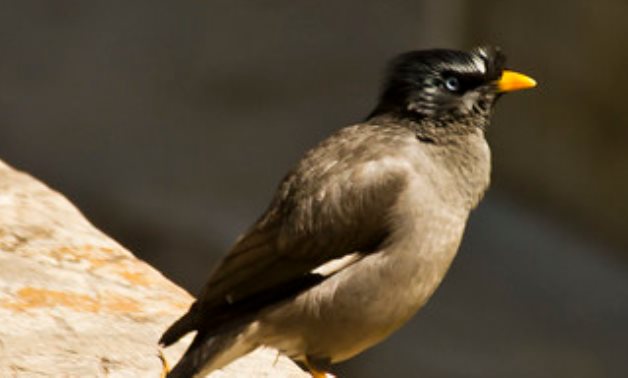
Indian Myna birds- cc via-Flickr/Antony Grossy




CAIRO - 11 June 2026: Egypt’s Ministry of Environment and Local Development stated on Thursday that it has launched a comprehensive tracking and containment program to combat the spread of the invasive Indian Myna bird (Common Myna or Acridotheres tristis) in the country.
According to the International Union for Conservation of Nature (IUCN), the bird is considered one of the 100 World's Worst Invasive Alien Species. It is approximately 23 to 26 centimeters long, and is characterized by a dark brown body, a black head and neck, with a bare yellow spot around the eye, and bright yellow beak and legs.
Minister of Environment, Dr. Manal Awad, clarified that this species’ original habitat is South Asia, noting that its first recorded appearance in Egypt was in 1999 in the Sinai Peninsula, before gradually spreading to a number of areas including the Canal cities, Greater Cairo, the Delta, some Upper Egypt areas, and coastal regions. However, according to a study published in Ornithological Society of the Middle East, the Caucasus, and Central Asia (OSME) in 2025, the first bird was recorded in Sukhna, south of Suez, in April 1998.
The Egyptian Minister attributed the Common Myna birds’ invasion in Egypt to certain keys: high reproductive rates, exceptional adaptability to varied environments, a diverse diet, the ability to nest in both urban buildings and trees, and a complete absence of natural predators in the local ecosystem.
The invasion of this bird covers about 0.8 percent of Egypt’s area (8240 km2 out of roughly 1 million km2) as of 2023, according to a study titled “Predicting the Invasion Range of the Common Myna, Acridotheres tristis Linnaeus, 1766 in Egypt under Climate Change” that was published in Multidisciplinary Digital Publishing Institute (MDPI), an open-source for scientific journals.
Measures to curb increasing population of Common Myna
The Minister added in the statement that the Ministry has started a plan to curb the breeding opportunities and invasion. The measures are as follow:
1- Removal of the existing nests and sealing the architectural cavities or holes to prevent future nesting attempts.
2- Periodic field evaluations to track, map, and assess the size of active flocks and swarms.
3- Cover the garbage bins, rapidly clear outdoor waste disposals that attract the birds.
4- Install specialized nesting boxes engineered specifically for native Egyptian birds, designed with entry dimensions that completely block the larger Myna birds.
The Ministry urges residents to refrain from breeding or keeping the Common Myna as pets and requests that citizens immediately report any large swarms or sightings to local environmental departments.
The threat of this species of birds boils down to negative affect on the native species and ecosystem. The bird was also monitored in several Arab countries like Lebanon, Turkey Jordan, and Saudi Arabia.

Be Social




Comments
Leave a Comment