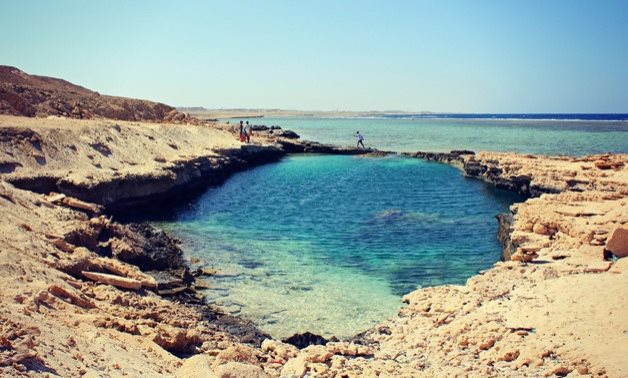
Al Nayzak, commonly called the Shooting Star, is one of the most scenic spots on the Red Sea – Flickr




CAIRO - 4 June 2026: Minister of Local Development and Environment Manal Awad affirmed that the Red Sea is one of the world's most important marine ecosystems due to its unique biodiversity and coral reefs of significant environmental, tourism and economic value.
She stressed that Egypt places great importance on preserving this natural wealth as a key pillar of sustainable development and eco-tourism, particularly in light of global environmental challenges and accelerating climate change.
Awad made the remarks during a meeting on Thursday, June 4, 2026, with Scientific Research Adviser at the Hurghada Environmental Protection and Conservation Association (HEPCA) Mahmoud Hanafy and association director Nour Farid to review efforts aimed at protecting the Red Sea marine environment and strengthening cooperation with civil society organizations working in the field of natural resource conservation and biodiversity protection.
The meeting discussed a number of projects and initiatives implemented by HEPCA in coral reef conservation, marine life protection, solid waste management and local community development.
Representatives of HEPCA presented the association's history and major environmental projects carried out in cooperation with relevant authorities to preserve natural resources and ensure the sustainability of marine ecosystems in the Red Sea.
The meeting reviewed in detail the solid waste management system operated by the association in the cities of Hurghada and Marsa Alam.
Representatives explained the stages of waste collection, transportation and management, noting that daily waste generation reaches around 400 tons. They also highlighted support for environmental projects, including scientific research on marine ecosystems, biodiversity conservation programs and marine mooring buoy projects designed to protect coral reefs.
Awad directed the Waste Management Regulatory Authority, the Red Sea Governorate and HEPCA to coordinate closely to assess the current system, identify challenges and develop clear mechanisms to improve efficiency and sustainability. She also called for completing the infrastructure needed for the system and expanding recycling facilities to maximize environmental and economic benefits.
The meeting also addressed efforts to reduce pressure on coral reefs caused by tourism and other marine activities.
HEPCA representatives reviewed the successful implementation of alternative diving sites created through the controlled sinking of decommissioned military equipment at selected locations in the Red Sea. The initiative aims to provide new attractions for divers while reducing pressure on environmentally sensitive natural coral reef sites.
Awad praised the model as a successful example of combining marine conservation with sustainable tourism and instructed relevant authorities to accelerate the establishment of four additional alternative diving sites.
The association further highlighted scientific studies showing that Red Sea coral reefs are among the most resilient in the world and possess a remarkable ability to recover from coral bleaching events, giving them global environmental significance.
The meeting reviewed HEPCA's marine mooring buoy program, which helps protect coral reefs from damage caused by direct anchoring by tourist and diving boats.
Representatives said around 1,400 mooring buoys have been installed across the Red Sea, supported by regular maintenance programs to ensure operational efficiency.
Plans to modernize the system and accommodate larger tourist vessels were also discussed. Awad directed support to expand the buoy network in South Sinai while ensuring sustainable maintenance and sufficient funding.
The meeting also examined a shark tracking program implemented by Egypt's Nature Conservation Sector in cooperation with HEPCA.
Hanafy explained that tracking devices have already been attached to a number of sharks to gather scientific data on their movement patterns, behavior and distribution across the Red Sea.
The meeting highlighted the local community development experience in the Qulaan area, which has become a leading model for integrating local residents into environmental conservation efforts.
Officials said the projects have helped transform residents from relying heavily on natural resource exploitation and traditional fishing to becoming active partners in conservation, improving economic and social conditions while supporting sustainable ecotourism.
At the conclusion of the meeting, Awad reaffirmed the ministry's commitment to continued cooperation with HEPCA and all relevant partners to protect the marine environment and biodiversity of the Red Sea.
She stressed that investing in the protection of natural resources is a direct investment in sustainable development, eco-tourism and the national economy, while safeguarding Egypt's natural capital for future generations.

Be Social




Comments
Leave a Comment