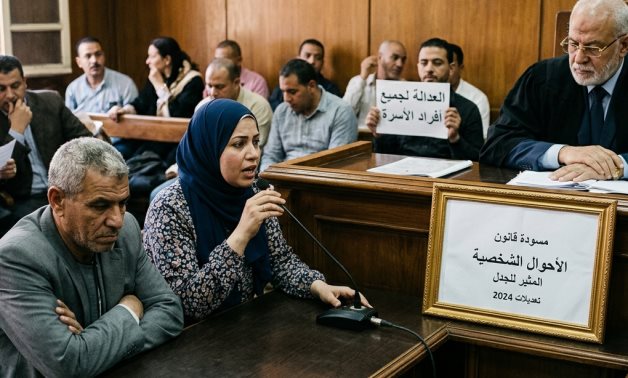
A picture- generated by AI via Nano banana- showing people at the courtroom and discussing the controversial Personal Status Law in Egypt




CAIRO – 21 May 2026: Social argument arose among Egyptians after introducing new amendments to the Personal Status Law regulating family affairs in light of the endless controversies regarding marriage and divorce.
The government-drafted law aims to decrease conflicts and legal and marital disputes between couples, as 1.7 million cases are pending before Egyptian family courts, according to the latest statistics issued by the Public Prosecution, Al Masry Al Youm reported in February 2026.
These cases include divorce, khula (divorce initiated by the wife), alimony, child custody, and visitation rights. Some outstanding alimony payments exceed substantial sums, reaching up to LE 1.7 million in individual cases annually, leading to complex legal disputes and complaints. This is an indicator of the extent of the social and economic changes that have affected the structure of the family.
The Personal Status Law in force was originally enacted in 1920. During remarks made on the Kalema Akhera program on ON TV on May 20, 2026, Judge Abdel-Rahman Mohamed, Head of the Committee for Drafting the Personal Status Law and former member of the Supreme Judicial Council, stated that the primary motivation behind preparing a new law was the severe legal complexity caused by the old legislation and its repeated amendments over more than a century.
According to Mohamed, the accumulation of amendments over the years created overlapping and sometimes contradictory provisions, making the current law difficult to apply and understand for both families and the courts.
On May 6, 2026, Prime Minister Mostafa Madbouly commented on the controversy surrounding the draft Personal Status Law, stating that the government is fully aware that such legislation will generate significant public debate. He noted that criticism is expected because the law addresses two opposing and often conflicting sides within family disputes.
The Prime Minister emphasized that the government remains open to amendments, opinions, and public discussion in order to reach the most balanced and appropriate legal framework possible.
Controversial articles
One of the controversial articles related with provisions granting the wife the right to request the annulment of the marriage contract within six months if it is proven that she was subjected to fraud or misrepresentation.
This includes cases in which the husband falsely claimed a certain social status or personal qualities, or concealed a disgraceful past, provided that the wife has not become pregnant or given birth.
The draft law also grants the wife the right to include special conditions in the marriage contract, provided they do not contradict the fundamental objectives of marriage.
These conditions may include:
- Her right to work.
- The husband’s commitment not to marry another woman.
- Her right to remain in the marital home in the event of divorce.
- Her right to initiate divorce proceedings.
If the husband violates any of these conditions, the wife has the right to request annulment of the contract although she may later waive those conditions if she chooses.
Insurance policy for the wife
The draft law requires the husband to provide an insurance policy for the benefit of the wife, guaranteeing her monthly financial support or alimony in cases of irrevocable divorce or court-ordered separation.
The policy details must be attached to the marriage or divorce certificate, and its implementation will be regulated by a decision issued by the Minister of Justice in coordination with insurance companies.
The draft law also grants the wife entitlement to the policy’s value upon the husband’s death, while allowing the husband to reclaim its value if he was not responsible for the divorce.
Documenting divorce
The draft law emphasizes the husband’s obligation to officially document the divorce within no more than 15 days from the date it occurs, whether the divorce is revocable or irrevocable.
Failure to comply will subject the husband to the penalties stipulated by law.
Most importantly, the draft explicitly states that a divorce does not produce its legal consequences regarding marital rights or inheritance until it is officially documented.
The law also requires the marriage registrar to formally notify the wife of the divorce and provide her with a copy of the document within 15 days of registration.
Another notable provision requires divorce cases occurring within the first three years of marriage to be presented before a judge in an attempt to reconcile the spouses.
The judge may consult religious leaders or social workers before authorizing the divorce, with the aim of reducing early divorce rates.
Khul’
The draft law affirms that divorce by mutual consent cannot be conditioned upon waiving the rights of the children.
The provisions governing Khul’ [allowing a Muslim woman to initiate a divorce by returning the mahr and everything she received from the husband during their life together] stipulate that the following rights cannot be forfeited:
● Child custody.
● Child maintenance.
● Any financial or legal rights belonging to the children.
● Custody-related expenses.
The law also requires the court to attempt reconciliation for up to two months before issuing a divorce ruling through two arbitrators selected from the families of both spouses.
Fathers’ rank in custody
The draft law reorganizes custody rights by placing the mother first in line for custody, followed immediately by the father, and then other female relatives.
The explanatory memorandum justifies this amendment by citing psychological and social problems arising from weak relationships between children and their fathers and paternal relatives.
The draft law sets the custody age at 15 years for both boys and girls, after which the child has the right to choose which eligible guardian they wish to live with.
Visitation
One of the most controversial provisions in the draft law is the expansion of visitation rights to include grandparents in addition to parents.
The draft law permits both in-person and online visitation, with a minimum duration of three hours per week, provided that the visitation takes place in an environment that is not psychologically or physically harmful to the child.
The law also introduces a “hosting” system, under which the child may stay with the non-custodial party for a specified period before being returned to the custodial parent. In some cases, this arrangement may include overnight stays.
Religious opinion
Some social media users opposed certain provision, especially the article allowing the wife to annul the marriage within a period of six months if the husband cheated, asking Al-Azhar Sheikhdom, the top Islamic Sunni religious institution, to reveal its opinion regarding the amendments.
However, Al-Azhar issued a statement on May 18, 2026, saying that the draft law has not yet been presented to Al-Azhar, nor did Al-Azhar participate in its drafting in any way.
The Media Center of Al-Azhar reiterated that Al-Azhar had previously submitted a proposed Personal Status Law in April 2019, presenting its Sharia-based perspective on the issue through a committee composed of senior scholars and specialized professors.
The statement clarified that Al-Azhar is currently unaware of the extent to which its proposal aligns with the draft law presently under discussion.
Al-Azhar’s Media Center also confirmed that Al-Azhar will issue its official Sharia opinion on the draft law, in accordance with the established constitutional and legal procedures once the bill is formally referred to the institution by the House of Representatives for review.
Advantages and disadvantages
Dr. Rasha Omar, Psychologist at the Ministry of Justice and Consultant in Mental Health and Family and Marital Counseling, told Egypt Today that the draft law has advantages and disadvantages.
She commented on the visitation provision, as an example, saying: “The draft law grants fathers the right to visitation and overnight stays with their children, while also setting clear conditions for exercising this right. The law further imposes penalties on fathers who fail to return the child to the mother after the visitation period. While these provisions are positive, they may also have certain drawbacks.”
She elaborated that in some cases, fathers may attempt to take revenge on the mother by influencing the child against her during visitation periods. Such behavior can negatively affect the child’s upbringing and emotional well-being, often as a result of ongoing conflict and stubbornness between the parents.
As an expert, Omar believes that overnight visitation should not necessarily become a permanent arrangement. Instead, the duration of visitation hours could be extended, or the number of visitation days per week could increase from one day to two. Once the child reaches the age of 15, the father may then be granted the right to host the child.
Regarding the wife’s right to annul the marriage contract within six months if it is proven that the husband married her through deception, Omar stated that this provision is fair to women and helps protect their psychological well-being by giving them legitimate grounds to end a marriage founded on deceit. However, the wife must provide strong evidence proving that deception occurred. She added that a woman’s right to dissolve a marriage contract is recognized under Sharia law, and that the proper and fair application of the law remains essential.
Regarding the wife's right to stipulate conditions in the marriage contract, Omar stated that such conditions have existed under the current law, which is a positive aspect, but the new law does not include them.
Omar continued that the compensation for divorce (mut'ah) is supposed to be for a minimum of two years in the applicable law. This means that if a marriage lasts for even a single day, the wife is entitled to compensation equivalent to two years' worth of the husband's financial means. However, the new law sets a maximum limit of LE 100,000 for this compensation. Omar believes this condition is detrimental to women's rights.
She said: “For example, if a wife is harmed by her husband taking another wife without informing her after 40 years of marriage, and the husband is a millionaire, the first wife is only entitled to LE 100,000 in compensation. This is unfair to the wife. The compensation should be commensurate with the husband's financial means, and there should be no maximum limit for this compensation.”

Be Social




Comments
Leave a Comment