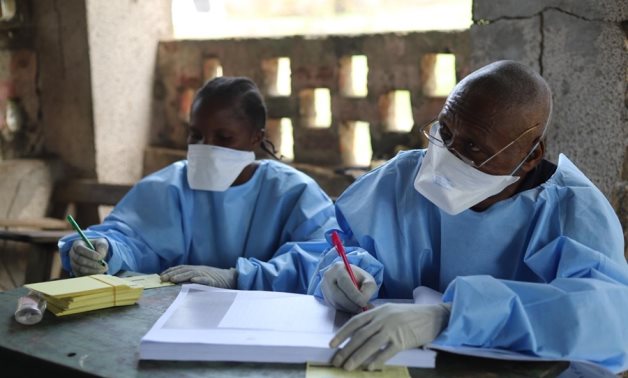
The Democratic Republic of the Congo declares end of 16th Ebola outbreak in December 2025. WHO




CAIRO – 24 May 2026: Egypt’s health ministry advised citizens on Sunday to postpone non-essential travel to countries affected by Ebola, while Africa health body has warned the outbreak could spread further in Africa.
The ministry said Egypt remained completely free of Ebola infections and that the risk to citizens is currently low.
It urged Egyptians who must travel to affected areas to strictly follow preventive measures issued by local health authorities and avoid direct contact with suspected cases or bodily fluids.
The ministry said its preventive medicine and public health sector has raised the level of preparedness at quarantine departments across all air, sea and land entry points by intensifying health screening procedures for arrivals from affected countries.
Travellers arriving from those countries would also be monitored for 21 days and advised to immediately seek medical attention or contact the ministry’s hotline if symptoms appear, including sudden fever, severe weakness, muscle pain, vomiting, diarrhea or unexplained bleeding.
Ebola spreads only through direct contact with bodily fluids such as blood, saliva and secretions, and is not airborne, the ministry reassured citizens, adding that infected individuals are not contagious before symptoms emerge.
The ministry affirmed continuing to monitor the outbreak around the clock in coordination with the World Health Organization (WHO) and will update precautionary measures in line with developments.
Ebola is a highly deadly viral disease with an average fatality rate of around 50%, according to WHO.
The current outbreak has been recorded mainly in DR Congo, with transmission concentrated in Ituri, North Kivu and South Kivu provinces, while Africa’s health body has warned of the risk of further spread.
On Friday, WHO said 82 Ebola cases and seven deaths have been confirmed so far in DR Congo, but warned the outbreak is likely far larger, with nearly 750 suspected cases and 177 suspected deaths reported.
The organization has raised its national risk assessment for DR Congo to “very high”, although it maintained that the global risk remained “low”.
Moreover, two travel-linked Ebola cases have also been confirmed in Uganda, including one death.
WHO has declared the Ebola outbreak in DR Congo and Uganda a “public health emergency of international concern.”
The Africa Centres for Disease Control and Prevention (Africa CDC) warned on Saturday that 10 African countries: Rwanda, Kenya, Tanzania, Angola, Burundi, the Central African Republic, the Republic of Congo, Ethiopia, South Sudan and Zambia are at risk from the outbreak.
The outbreak involves the Bundibugyo strain of Ebola, for which there are currently no approved vaccines or treatments.
According to the UN, only two previous outbreaks of the strain have been recorded, in Uganda in 2007 and DR Congo in 2012.

Be Social




Comments
Leave a Comment