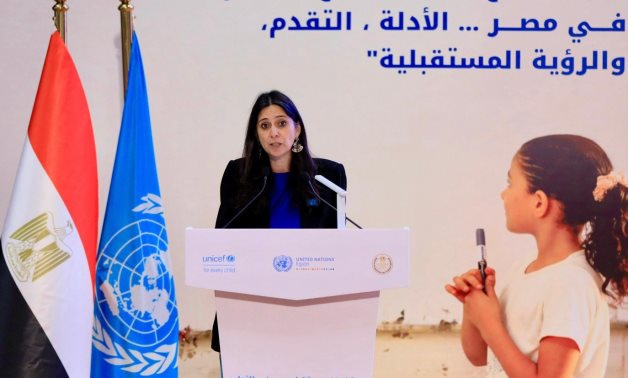




CAIRO – 20 May 2026: Natalia Rossi, UNICEF Representative in Egypt, affirmed that her participation in the “Envisioning Egypt’s Future in Education” conference comes at a crucial moment for education reform in the country.
In her remarks, Rossi welcomed Prime Minister Mostafa Madbouly and expressed deep appreciation for Egypt’s continued leadership and commitment to the nation’s children and youth.
She noted that the Prime Minister’s presence sends a powerful national message: that education is not merely a sectoral priority, but a cornerstone of Egypt’s long-term development, prosperity, stability, and progress.
Rossi also expressed UNICEF’s appreciation to the Ministry of Education and Technical Education for its vision, leadership, and continued efforts to advance education reform nationwide. She further commended the contributions of the UN Country Team, the Global Partnership for Education, and development partners in supporting children’s rights and human development.
The UNICEF representative stressed that the discussion goes beyond education reform itself, explaining that it concerns Egypt’s future, which is being shaped through its children and youth.
She emphasized that strong education systems build strong nations, noting that Egypt has embarked on one of the region’s most ambitious education reform plans over the past two years. Rossi said the country’s achievements deserve genuine recognition, as reforming an education system of this scale requires leadership, determination, and a firm belief that every child — regardless of background, location, or circumstances — deserves an equal opportunity to succeed.
Rossi added that Egypt has successfully translated aspirations into practical action and reforms into tangible change benefiting children across the country. She explained that the results of the rapid assessment of education reform implementation, led by UNICEF in coordination with the Ministry of Education and Technical Education and supported by UN teams, reflect real momentum within the Egyptian education system.
She noted that the comprehensive Education Sector Analysis published by UNICEF in 2021 revealed an education system facing immense pressures, including overcrowded classrooms, teacher shortages, challenges related to school attendance, and pressures affecting the quality of education and investment in the sector. Despite these significant challenges, Rossi said Egypt chose to move forward.
The UNICEF representative affirmed that there are encouraging signs showing the reforms have already begun transforming the learning experience for children in Egypt. She explained that more children are attending school regularly, classroom overcrowding is decreasing, teachers feel more supported, foundational learning is improving, and curriculum reforms are being positively received in schools and local communities.
“These are not minor changes,” Rossi stressed, “but early indicators of genuine transformation.”
She added that behind every statistic presented lies the real-life experience of a child. Rossi cited one student as saying: “Before joining the program, I struggled with reading and writing. Now I can read well and write stories, and I feel proud of myself.”
She also quoted a teacher who said: “Previously, children were shy and afraid of making mistakes. Now they raise their hands, participate confidently, and believe in their abilities.”
Rossi said this represents the true meaning of progress: children gaining self-confidence, believing in their abilities, and beginning to envision broader opportunities for their future.
She noted that this progress is rooted in sustained national commitment, emphasizing that Egypt continues to prioritize investment in education year after year because of its pivotal role in long-term development and future prosperity.
Rossi added that education remains a central pillar of the partnership between the Egyptian government and the United Nations, as well as at the core of UNICEF’s commitment to supporting every child’s right to learn, grow, and thrive.
She stressed that reforms of this magnitude are not achieved by chance, but require strong leadership, sustainable investment, long-term commitment, strategic partnerships, and shared responsibility among the government, the United Nations, development partners, governorates, educational administrations, teachers, families, and local communities to turn reforms into a daily reality for children.
The UNICEF representative also emphasized that education reform is not solely about improving educational systems, but about preparing young people for the future Egypt aspires to build — a future defined by strength and prosperity.
Rossi outlined four key priorities for the coming period. These include continuing investment in education through sound planning, equitable resource allocation, and a focus on achieving measurable outcomes for children; prioritizing foundational learning, particularly literacy, numeracy, and social-emotional skills; and continuing to invest in teachers, recognizing their central role in the development process.
She added that another priority is expanding smart digital transformation by leveraging technology to enhance teaching and learning and broaden educational opportunities for all children, rather than adopting technology for its own sake.
Rossi also announced that Egypt has been selected as one of the first countries worldwide to receive technical assistance and additional funding under UNICEF’s Global Strategy for Digital Education and Artificial Intelligence. The initiative will provide $1 million over two years to support strategic interventions in digital education.
She emphasized that this selection reflects Egypt’s leadership, ambition, and growing momentum in advancing digital learning and education reform.
In closing, Rossi affirmed that the rapid assessment results provide clear evidence that change has already begun and offer confidence that even greater progress can be achieved in the future.
She said Egypt presents a model demonstrating that real change is possible, comprehensive reform is achievable, and the rights and potential of every child can be realized.
Rossi added that the issue extends beyond education alone to encompass the future of Egypt’s labor market, economic growth, social progress, and opportunities for millions of young people.
She called for continuing the reform journey by building an education system that keeps pace with the energy, aspirations, and potential of Egyptian youth, stressing that Egypt’s future is already taking shape in classrooms today.
The UNICEF representative concluded by emphasizing that sustained leadership, partnership, and commitment will not only strengthen the education system, but also reinforce the future of the nation as a whole.

Be Social




Comments
Leave a Comment