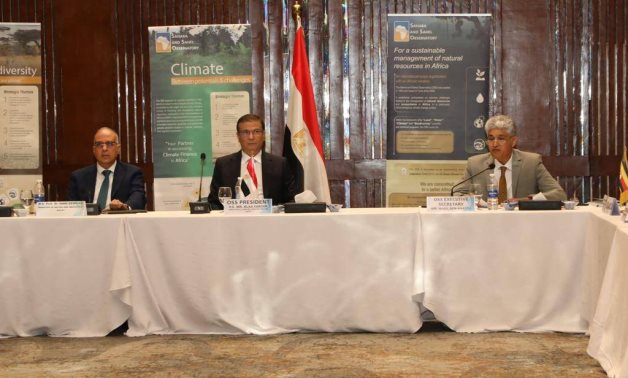
Cairo hosts the 33rd meeting of the Board of Directors of the Sahara and Sahel Observatory (OSS) on April 27, 2026-press photo




CAIRO- 27 April 2026: Egypt reaffirmed its commitment to supporting water sustainability and strengthening regional cooperation during the opening session of the 33rd meeting of the Board of Directors of the Sahara and Sahel Observatory (OSS), held in Cairo with high-level international participation.
The session brought together ministers and senior officials from several African countries, alongside representatives of regional and international organizations. Among those in attendance were Egypt’s Minister of Agriculture and Land Reclamation, Alaa Farouk, who also chairs the Observatory’s Board of Directors, and Minister of Water Resources and Irrigation, Dr. Hani Sweilem, as well as ministers responsible for environment and water from Tunisia, Uganda, and Chad.
In his opening remarks, Farouk emphasized that hosting the meeting in Cairo reflects a growing recognition of the urgent need for regional integration and collective action in the face of escalating climate change and mounting pressure on natural resources. He described the gathering as an opportunity to renew commitments to sustainable development across member states.
Farouk highlighted the Observatory’s role as a trusted regional and international partner, noting its achievements in natural resource management and climate adaptation. He stressed that current challenges, including water scarcity, land degradation, desertification, and biodiversity loss—require coordinated and science-based responses.
The minister also outlined key priorities for the coming phase, including improving program implementation, strengthening financial sustainability, enhancing governance, and expanding partnerships. He underscored the importance of member states fulfilling their financial commitments to ensure the continuity and effectiveness of the Observatory’s work.
For his part, Dr. Hani Sweilem emphasized that water resources are central to sustainable development, given their close links to land, ecosystems, and climate systems. He called for the adoption of integrated water resources management approaches, particularly in arid and semi-arid regions facing compounded environmental pressures.
Sweilem noted that challenges such as climate change, biodiversity loss, and desertification require enhanced regional cooperation, data sharing, and the use of advanced technologies. He highlighted the Observatory’s role in supporting member states through capacity building, scientific tools, and data-driven decision-making.
He also pointed to the importance of modern technologies, including geographic information systems and remote sensing, as well as early warning systems, in improving environmental monitoring and strengthening resilience to climate risks.
The meeting is expected to produce recommendations aimed at reinforcing the role of the Sahara and Sahel Observatory and supporting member states in achieving sustainable development while preserving vital natural resources.

Be Social




Comments
Leave a Comment