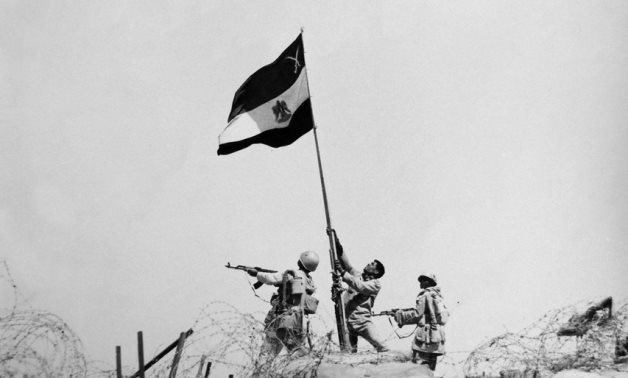




CAIRO – 22 April 2026: Egypt celebrates Sinai Liberation Day on April 25th, commemorating the Egyptian army's historic crossing of the Suez Canal in 1973 and its victory over the Israeli occupation forces. This triumph led to the complete withdrawal of Israel as an occupying state and the raising of the Egyptian flag over Sinai after its full liberation.
This day represents the final chapter in a long series of Egyptian-Israeli conflicts, culminating in the complete recovery of Egyptian territory following a resounding political and military victory on April 25, 1982.
However, the story of liberation and the return of Sinai to Egypt did not begin with the war on October 6, 1973, but rather more than six years prior. The battlefront witnessed fierce fighting whose outcomes shocked the Israeli military establishment and served as the initial spark for the war.
The Story of the Return of Sinai
The confrontation on the battlefront began in September 1968 and continued until October 6, 1973—the decisive day when Egyptian forces launched the "Crossing War."
Egypt waged this war against Israel, breaching the Suez Canal and the Bar Lev Line. Among its most important outcomes were the restoration of full sovereignty over the Suez Canal, the recovery of a portion of the Sinai Peninsula, and the resumption of navigation in the Suez Canal in June 1975.
The liberation war also achieved direct results on both global and local levels, including a shift in military standards worldwide. This influenced global military strategies and impacted the future of many weapons and equipment types in both the East and West. Furthermore, it restored the confidence of the Egyptian and Arab fighters in themselves, their leadership, and the justness of their cause.
Most importantly, it shattered the myth of Israeli invincibility; the state was no longer the unbeatable power it had portrayed itself to be. The war transformed the Arab nations into an international force with significant influence, and Arab unity was manifested in its most magnificent form.
The October War paved the way for the Camp David Accords between Egypt and Israel, signed in September 1978, following President Sadat's historic initiative in November 1977 and his visit to Jerusalem.
Political Negotiations
After the sixteenth day of the October War, the second phase began, aimed at completing the liberation of the land through political negotiations.
Resolution 338 was issued, calling for a cessation of all hostilities starting on October 22, 1973. This followed intervention by the United States and other members of the Security Council. Egypt accepted and implemented the resolution that same evening. However, Israeli forces violated the ceasefire, leading the Security Council to issue another resolution on October 23, obligating all parties to cease fire.
Israel eventually complied and agreed to this resolution, entering into military talks to separate the forces. This resulted in a cessation of hostilities on October 28, 1973, with the arrival of the United Nations Emergency Force (UNEF) on the Sinai front.
The First and Second Disengagement Agreements
In January 1974, the first disengagement agreement between Egypt and Israel was signed. It defined the line to which Israeli forces would withdraw—extending 30 kilometers east of the Suez Canal—and established the buffer zone where the United Nations Emergency Force (UNEF) would be stationed.
In September 1975, the second agreement was signed, under which Egypt advanced to new lines, regaining approximately 4,500 square kilometers of Sinai territory. A key provision of the agreement stipulated that the conflict in the Middle East would not be resolved by military force, but rather through peaceful means.
President Anwar Sadat's Initiative to Visit Jerusalem
In a statement before the People's Assembly, President Anwar Sadat announced his readiness to go to Israel. He did so in November 1977, addressing the Israeli Knesset and presenting his initiative. A key point of this initiative was that signing any separate agreement between Egypt and Israel was out of the question and not part of Egypt's policy. He emphasized that any peace between the confrontation states and Israel without a just solution to the Palestinian issue would never achieve the lasting peace that the entire world demanded.
The Camp David Summit
On September 5, 1978, Egypt and Israel agreed to the American proposal to hold a tripartite summit at Camp David in the United States. An agreement was announced on September 17 of the same year, and the Camp David Accords were signed at the White House on September 18, 1978.
The agreement contained two important documents aimed at achieving a comprehensive settlement to the Arab-Israeli conflict:
The first document, the Framework for Peace in the Middle East, stipulated that the articles of the UN Charter and other rules of international law and legitimacy now provide acceptable standards for the conduct of relations between all states.
Achieving a relationship of peace in accordance with the spirit of Article 2 of the UN Charter and conducting future negotiations between Israel and any neighboring state willing to negotiate peace and security is essential for the implementation of all provisions and principles of Security Council Resolutions 242 and 338.
The second document; The Framework Agreement for a Peace Treaty between Egypt and Israel: Egypt and Israel signed the Peace Treaty on March 26, 1979, convinced of the urgent need to establish a just, comprehensive, and lasting peace in the Middle East in accordance with Security Council Resolutions 242 and 238, and reaffirmed their commitment to the Framework for Peace agreed upon at Camp David.
The Peace Treaty
On March 26, 1979, Egypt and Israel signed the Peace Treaty, convinced of the urgent need to establish a just and comprehensive peace in the Middle East. The treaty stipulated the end of the war between the two parties, the establishment of peace, and the withdrawal of all Israeli armed forces and civilians from Sinai to beyond the international border between Egypt and Mandatory Palestine. Egypt would then resume exercising its full sovereignty over Sinai.
Sinai is an Egyptian Land
The peace treaty between Egypt and Israel led to a complete Israeli withdrawal from the Sinai Peninsula and the return of Egyptian sovereignty over all its territory. A timetable for the phased withdrawal from Sinai was established as follows:
May 26, 1979: The Egyptian flag was raised over the city of El Arish, and Israel withdrew from the El Arish/Ras Muhammad line, marking the beginning of the implementation of the peace agreement.
July 26, 1979: The second phase of the Israeli withdrawal from Sinai (an area of 6,000 square kilometers) began, from Abu Zenima to Abu Khurba.
November 19, 1979: The South Sinai Governorate received its official mandate from the Egyptian Armed Forces after they fulfilled their duty of liberating the land and achieving peace.
On the same day, Israel withdrew from the Saint Catherine and Wadi El-Tor areas, and this day was designated as the National Day of the South Sinai Governorate.
On April 25, 1982, the Egyptian flag was raised on Egypt's eastern border in the cities of Rafah in North Sinai and Sharm El Sheikh in South Sinai, marking the completion of the Israeli withdrawal from Sinai after a 15-year occupation.
This day was declared a national holiday in Egypt, commemorating the liberation of every inch of Sinai except for the final part: the Taba issue. This dispute was created by Israel in the final days of its withdrawal. The diplomatic battle to liberate this precious territory took seven years of intensive Egyptian effort.
The Return of Taba
During the final Israeli withdrawal in 1982, the conflict over Taba erupted. Egypt clearly stated its position: there would be no concessions or relinquishment of Taba. Any border disputes had to be resolved according to Article 7 of the Egyptian-Israeli Peace Treaty, which stipulates:
Disputes concerning the application or interpretation of this Treaty shall be settled through negotiations.
If such disputes cannot be settled through negotiations, they shall be settled by conciliation or referred to arbitration.
Egypt's position was clear as it sought arbitration, while Israel initially preferred conciliation. On January 13, 1986, Israel announced its acceptance of arbitration. Negotiations culminated in an "Arbitration Agreement" signed on September 11, 1986, which defined the terms of arbitration and the court's mandate to determine the disputed border markers.
On September 30, 1988, the international arbitration panel in Geneva issued its ruling, unanimously declaring Taba to be Egyptian territory. On March 19, 1989, the Egyptian flag was finally raised over Taba.

Be Social




Comments
Leave a Comment