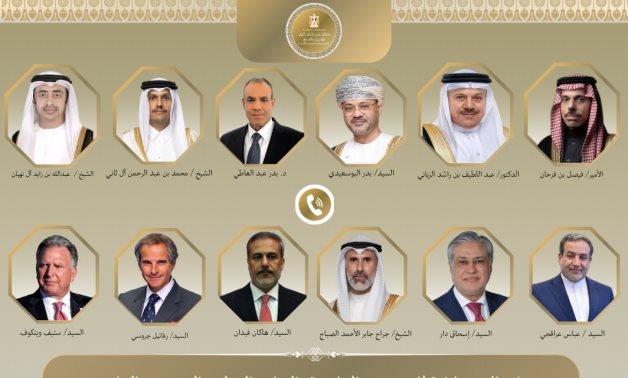
Egyptian Minister of Foreign Affairs Badr Abdelatty held separate telephone conversations on April 4 with US Special Envoy Steve Witkoff and several regional counterparts




CAIRO – 5 April 2026: Egyptian Minister of Foreign Affairs Badr Abdelatty held separate telephone conversations on April 4 with US Special Envoy Steve Witkoff and several regional counterparts, including Iranian Foreign Minister Abbas Araqchi. The discussions focused on proposals to de-escalate regional tensions, particularly in light of the approaching deadline set by US President Donald Trump for a response to the American proposal.
During the calls, the parties exchanged views and proposals on ways to reduce military escalation in the region.
Abdelatty emphasized the importance of exercising wisdom to defuse tensions and prevent further escalation and destruction. He stressed the need to prioritize dialogue and diplomacy in order to preserve regional security and stability and promote the common good.
He also reviewed Egypt’s intensive efforts and ongoing contacts with regional and international partners aimed at reducing tensions. Abdelatty discussed various ideas and proposals to achieve the necessary calm, warning that the current escalation risks triggering an unprecedented regional crisis, along with severe economic and geopolitical consequences.
The minister reaffirmed Egypt’s categorical rejection of targeting civilian facilities and infrastructure, noting that such actions lead to the destruction of vital resources. He reiterated Egypt’s firm condemnation of all attacks targeting the Gulf states, Jordan, and Iraq, and underscored Egypt’s rejection of any violation of the security and sovereignty of Arab states. He called for the immediate cessation of such attacks, describing them as a blatant violation of Arab sovereignty and a clear breach of international law and the Charter of the United Nations.
The calls also emphasized the importance of continued consultations, coordination, and intensified diplomatic efforts in the coming period to de-escalate tensions, resolve the crisis, and prevent serious consequences for food and energy security, as well as for regional and international peace and security.
The discussions included Mr. Steve Witkoff, US Special Envoy to the Middle East; Prince Faisal bin Farhan, Minister of Foreign Affairs of Saudi Arabia; Sheikh Abdullah bin Zayed, UAE Deputy Prime Minister and Minister of Foreign Affairs; Sheikh Mohammed bin Abdulrahman Al Thani, Qatari Prime Minister and Minister of Foreign Affairs; Sheikh Jarrah Jaber Al-Ahmad Al-Sabah, Minister of Foreign Affairs of Kuwait; Abdullatif bin Rashid Al-Zayani, Minister of Foreign Affairs of Bahrain; Hakan Fidan, Minister of Foreign Affairs of Turkey; Mohammad Ishaq Dar, Deputy Prime Minister and Minister of Foreign Affairs of Pakistan; Abbas Araqchi, Minister of Foreign Affairs of Iran; and Mr. Rafael Grossi, Director General of the International Atomic Energy Agency.
On his Truth Social, US President Donald Trump has given Iran a 48 hours to open the Hormuz Strait or face “devastating consequences.” “Remember when I gave Iran ten days to MAKE A DEAL or OPEN UP THE HORMUZ STRAIT. Time is running out - 48 hours before all Hell will reign down on them. Glory be to GOD! President DONALD J. TRUMP, he wrote.

Be Social




Comments
Leave a Comment