
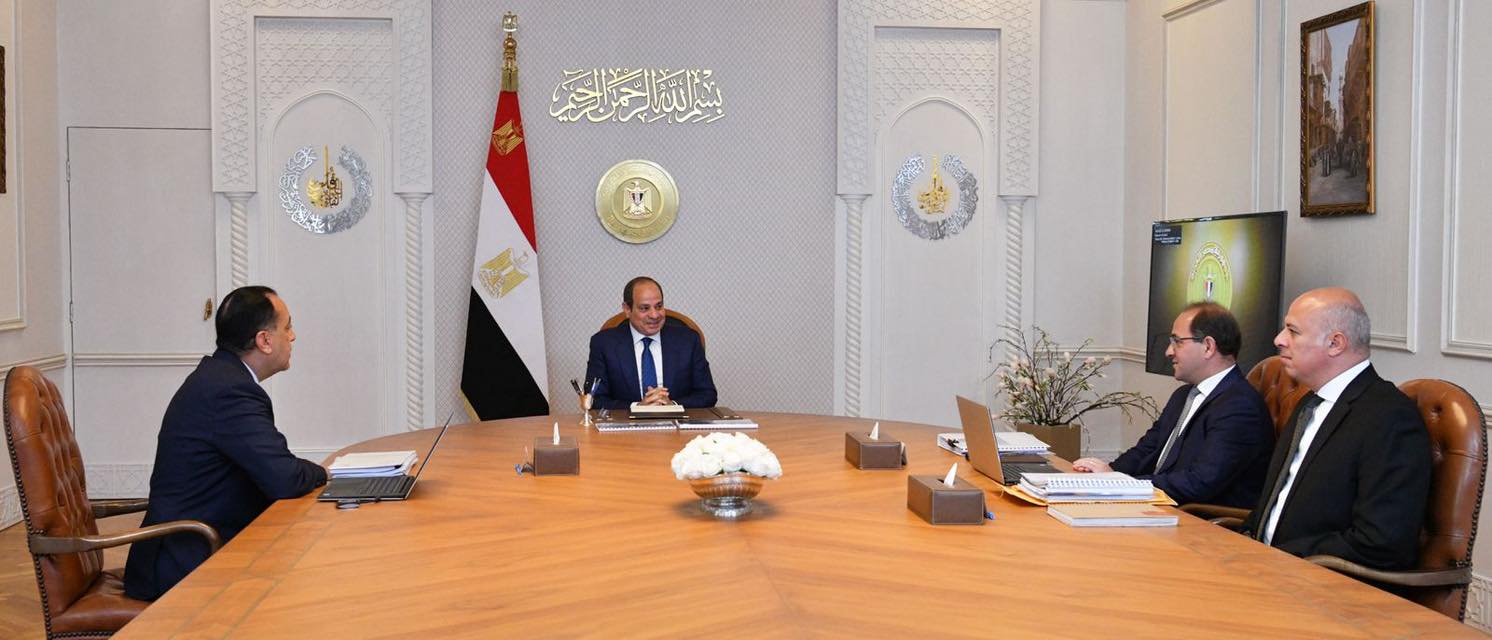
President Abdel Fattah El-Sisi reviewed the fiscal policy during a meeting with Prime Minister Mostafa Madbouly and Finance Minister Ahmed Kouchouk, 24 March 2026. Presidency




CAIRO – 24 March 2026: President Abdel Fattah El Sisi on Tuesday reviewed short- and medium-term fiscal policy priorities for the 2026/2027 budget with a vision blending growth and fiscal discipline.
The state’s fiscal policy includes establishing a new partnership with the business community to boost confidence, improve services, and enhance policy clarity, the Presidency said in a statement.
The plans also include implementing targeted tax and customs facilitation measures and expanding the tax base by increasing compliance without imposing new burdens on citizens or businesses, the statement said.
El-Sisi reviewed the fiscal policy during a meeting with Prime Minister Mostafa Madbouly and Finance Minister Ahmed Kouchouk, directing continued institutional reform and sound governance.
Major Growth, Stable Inflation
The finance minister noted that the fiscal policy aims to strike a balance between promoting economic growth, enhancing Egypt’s competitiveness, and maintaining fiscal discipline.
The government also targets economic growth of 5.4%, stable inflation, and the allocation of LE 90 billion to programs supporting economic activity linked to measurable outcomes, alongside continued energy subsidies and a primary surplus of LE 1.2 trillion.
Debt Service, Wage Increase
Kouchouk added that debt service indicators are expected to improve significantly, with continued efforts to reduce the debt-to-GDP ratio.
Fiscal priorities also include meaningful increases in health and education spending, higher wages for teachers, and real wage increases for public sector employees tied to performance and exceeding inflation rates.
The meeting reviewed proposals for wage increases, key policies aimed at reducing budget sector debt and debt servicing costs.
Discussions covered measures to achieve higher growth rates, support the private sector, rely on goods and services exports as a primary driver of growth, boost productivity, expand spending on research and development, and encourage private investment.
Fiscal Balance Amid Challenges
The meeting also reviewed targeted indicators for growth, primary surplus, expenditures, and revenues.
El-Sisi also checked on government efforts to achieve fiscal balance to enhance overall economic performance, particularly in light of mounting regional challenges and their economic repercussions.
The minister stressed that the government is continuing reforms to ensure fiscal and economic stability and to stimulate private sector growth.
Additionally, the government is committed to maintaining economic activity, production, manufacturing, and exports through balanced, investment-friendly fiscal policies, he added.
Kouchouk also highlighted the continuation of tax, customs, and real estate facilitation measures to ease burdens on citizens and investors.
Presidential Directives
The president emphasized the need to continue comprehensive institutional reform.
This aims to ensure fiscal discipline and sound governance by rationalizing public spending, enhancing revenues, and reducing public debt, thereby strengthening the economy’s resilience in the face of various challenges.
He also directed the government to continue efforts aimed at attracting more domestic and foreign investment, while maintaining direct and positive engagement with global investment communities and clearly communicating Egypt’s economic measures to contain regional repercussions.

Be Social




Comments
Leave a Comment