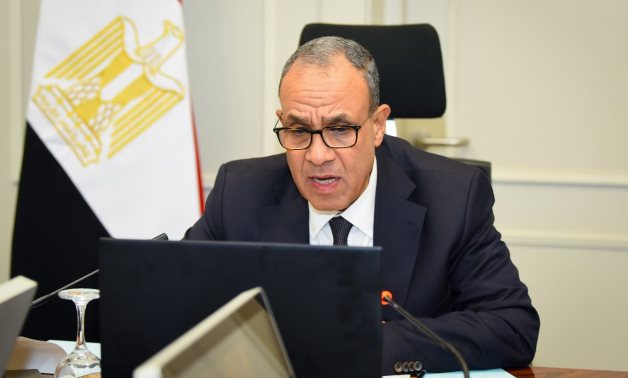
Egypt’s Foreign Minister Badr Abdelatty speaks during a virtual Egypt–GCC ministerial meeting focused on de-escalation and maritime security.




CAIRO - 13 MARCH 2026: Egypt’s Foreign Minister Badr Abdelatty has joined the fourth joint ministerial meeting between Egypt and the Gulf Cooperation Council (GCC). During the session, he pushes a message as the region faces fast-moving military escalation.
Abdelatty has stressed the priority now is to stop the conflict from widening, protect Gulf states from further attacks, and keep global trade lanes open.
The meeting was held virtually under the chairmanship of Bahrain’s Foreign Minister Abdullatif bin Rashid Al Zayani, in his capacity as president of the current GCC ministerial session, with GCC Secretary-General Jasem Mohamed Al Budaiwi attending.
Abdelatty reaffirmed Egypt’s firm support for Gulf states and solidarity with them in what he described as unacceptable Iranian attacks.
He also rejected any justifications in harming the sovereignty or capabilities of Gulf states, and extended that position to Jordan and Iraq, warning that targeting the security of sister states pushes the region toward a much wider and harder to control confrontation.
The foreign minister’s remarks focused heavily on consequences. Not only the immediate security fallout, but the wider economic shock that comes when conflicts expand.
He warned of the risks of a broader conflict and the possibility of sliding into “comprehensive chaos,” and stressed the need to guarantee freedom of international maritime navigation, describing any attempt to obstruct shipping as a direct threat to regional stability and global trade.
Abdelatty also used the Egypt–GCC platform to revive the idea that Cairo has been emphasizing more strongly in recent days: that Arab states need stronger collective security tools.
He called for activating frameworks of joint Arab national security, including the Joint Arab Defense Treaty and the formation of a joint Arab force, arguing that the region cannot keep absorbing repeated crises without a more durable, collective response.
The message fits a wider diplomatic line Egypt has been pressing during the escalation, that de-escalation must move quickly, diplomacy must stay open, and regional security cannot be treated as separate files when the spillover affects everyone.

Be Social




Comments
Leave a Comment