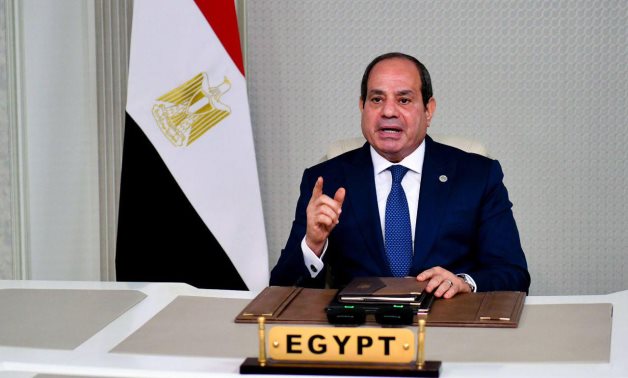
President Abdel Fatah al-Sisi - file




CAIRO - 9 March 2026: Amid the escalating risks of war that erupted between Iran and Israel by the end of February, Egypt has taken immediate measures and economic, political and monetary decisions.
Governmental measures
Atop of these decisions came Egypt’s decision to place essential commodity stocks under direct monitoring to ensure their availability.
In order to secure commodities, Egyptian Prime Minister Mostafa Madbouly, in coordination with the Minister of Supply Sherif Farouq, ensured the availability of a secure stock of essential commodities sufficient for several months and their release into the markets to prevent unjustified price increases.
The Central Bank and state institutions implemented measures to address the outflow of approximately $2.5 billion in foreign investment driven by regional tensions, and the depreciation of the Egyptian pound against the dollar.
The repercussions of the halt in Israeli gas supplies and the impact of tensions in the Strait of Hormuz on trade and the Suez Canal were also assessed in terms of energy and navigation monitoring.
Egypt also continued its diplomatic efforts to mediate and de-escalate regional tensions, while addressing currency fluctuations and the outflow of foreign investment.
Sisi re-assuring Egyptians
On March 1, President Abdel Fattah al-Sisi issued a stark warning regarding escalating regional conflict, noting that continued instability and the potential closure of the Strait of Hormuz could further cripple global energy flows and maritime trade.
This came during the military’s annual Iftar marking the 10th of Ramadan victories.
President Abdel Fattah al-Sisi said in a televised statement to Egyptians: “No need to worry about Egypt. We have ensured the availability of strategic commodities amid the ongoing crisis.”
Sisi emphasized that modern warfare inevitably inflicts negative consequences on both combatant nations and their neighbors, particularly as combat technologies evolve.
He noted that "miscalculations" in these conflicts result in severe repercussions for regional balance, extending beyond humanitarian concerns to fundamental state stability.
As a stakeholder in regional security, Sisi confirmed he has held discussions with Gulf and Arab counterparts to reiterate Egypt's rejection of any aggression against sovereign states and to affirm support for allies facing these crises.
The President said Egypt has faced significant material losses since 7 October, as navigation in the Suez Canal has yet to return to its normal patterns. He emphasized that the state must now prepare for all possibilities and scenarios, particularly the risk of a total blockade at the Strait of Hormuz.
"The closure of the Strait of Hormuz will impact oil flows and prices," Sisi noted in a Sunday statement, adding that while Egypt has secured necessary reserves to stabilize the domestic front, the duration of the crisis remains an unpredictable variable.
Intensive diplomatic efforts
Egypt has exerted intensive diplomatic efforts to prevent the region from sliding into a full-blown regional war, especially given the escalating tensions and military operations exchanged between Iran on one side, and the United States and Israel on the other.
Cairo affirms that diplomacy and dialogue are the only way to resolve the current crises and rejects any pretexts for legitimizing aggression against states.
Reflecting on Egypt's diplomatic role, Sisi described a "sincere effort" over recent months to bridge the gap between the United States and Iran.
Despite these mediation attempts, the President expressed skepticism regarding an immediate cessation of hostilities. "In Egypt, we were keen to emphasize the importance of non-escalation and achieving calm," Sisi said, "though I doubt that [a ceasefire] will be achieved.”
Moreover, El-Sisi condemned Iranian attacks on Arab countries at a time when Gulf countries and other regional actors have been working to de-escalate tensions and pursue a diplomatic solution to Iran’s nuclear file.
On Monday, President Sisi participated in an emergency meeting of European Union leaders and Middle East heads of state, amid growing fears of a wider regional confrontation, as Iran responded to US-Israeli strikes by launching retaliatory attacks on US bases in Gulf states, as well as in Jordan and Iraq.
President Sisi called for an immediate halt to attacks on Arab states and urged all sides to pursue dialogue.
“We emphasize the need for an immediate end to all attacks on our brotherly Arab states,” he said, stressing that crises must be resolved through peaceful means.
"The international community has a shared responsibility to work together to defuse this crisis," El-Sisi added.

Be Social




Comments
Leave a Comment