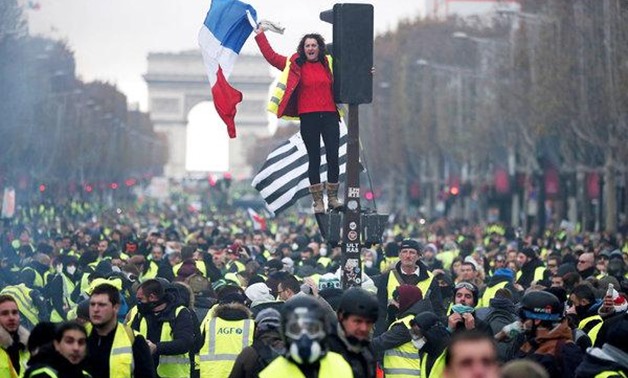
Protesters on the Champs-Élysées on Saturday, wearing the yellow safety jackets French motorists are obliged to carry. .




CAIRO - 9 March 2026: Thousands of demonstrators took to the streets around the world on March 8 to mark International Women’s Day, using the occasion not only to celebrate women’s achievements but also to protest war, violence, and political repression.
The demonstrations, held during the 115th anniversary of the global observance, focused on a wide range of issues including gender-based violence, international conflicts, environmental protection, and accountability for sexual crimes.
In Spain, large crowds gathered in major cities where many women called for an end to the ongoing US-Israeli war against Iran. The protests came amid tensions between Madrid and Washington after the Spanish government declined to allow its military bases to be used for attacks against Iran.
Spain’s Second Deputy Prime Minister, Yolanda Díaz, emphasized the importance of defending peace and protecting civilians, particularly Iranian women affected by the conflict. The calls for peace intensified following reports that 165 schoolgirls were killed on the first day of the joint US-Israeli strikes on Iran when a primary school in the city of Minab was hit in what became one of the deadliest civilian incidents of the conflict.
In France, more than 150 protests were organized across the country. One of the most prominent demonstrations in Paris was led by Gisèle Pelicot, a 73-year-old survivor of sexual violence who has become a global symbol in the fight against sexual abuse. Pelicot gained international attention after she waived her right to anonymity during the trial of her former husband and several other men accused of assaulting her while she was unconscious.
Across the Atlantic, activists gathered at Zorro Ranch in Albuquerque, New Mexico, a property linked to the late convicted sex offender Jeffrey Epstein. Protesters highlighted the need for accountability for those connected to Epstein’s crimes and criticized what activists described as a culture of impunity protecting powerful individuals.
In New York City, demonstrators assembled outside Trump Tower during a protest titled “Believe Survivors.” The rally followed the release of documents by the US Department of Justice containing details from an FBI interview with a woman who alleged that President Donald Trump sexually assaulted her when she was a minor.
Environmental concerns also featured prominently in some demonstrations. In the Amazonian town of Puyo in Ecuador, members of Indigenous communities gathered to protest environmental degradation and the expansion of oil and gas activities in the region. Participants called for stronger policies to protect forests and preserve Indigenous ways of life.
In Brazil, protests were fueled by outrage over the alleged gang rape of a 17-year-old girl in Rio de Janeiro’s Copacabana district earlier this year. The case gained national attention after four suspects turned themselves in to authorities during the same week as the demonstrations.
Meanwhile, in Pakistan’s capital Islamabad, police briefly detained several women’s rights activists who attempted to organize a march despite a government ban on public gatherings imposed amid rising armed violence in the country. The Aurat March network condemned the crackdown, stating that participants were exercising their right to peaceful protest.
Demonstrations also took place in several other countries. Activists in Istanbul chanted slogans demanding women’s rights, while in China and Russia the day was marked with the traditional sale of pink-wrapped flowers. In Phnom Penh, Cambodia, local workers celebrated the occasion by raising their fists and umbrellas in solidarity.
International Women’s Day, which the United Nations officially recognized in 1977, commemorates more than a century of activism for women’s rights. While the day celebrates progress and achievements, this year’s demonstrations highlighted the persistent global challenges facing women and underscored the continuing demand for justice, equality, and peace.

Be Social




Comments
Leave a Comment