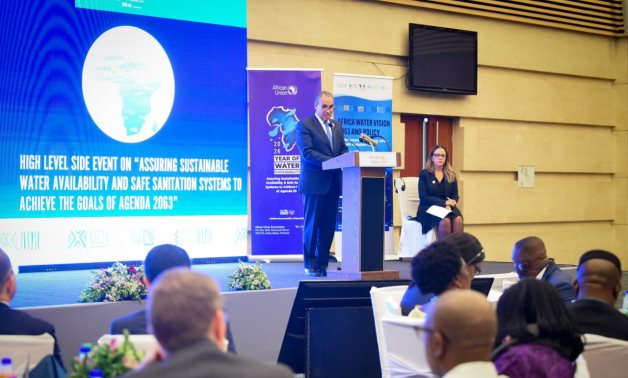




CAIRO — 16 February 2026: Egypt’s Minister of Foreign Affairs, International Cooperation, and Egyptians Abroad, Badr Abdelatty, participated in a high-level side event titled "Ensuring the Sustainability of Water and Sanitation Systems to Achieve the Goals of Agenda 2063," held on the sidelines of the African Union Summit. The event was attended by several African water ministers.
Abdelatty praised the adoption of the "Africa Vision 2063," noting that it represents a comprehensive framework for enhancing the sustainable management of water resources across the continent. He highlighted the inclusion of crucial principles regarding the management and use of transboundary water resources—principles that Egypt has long advocated for and emphasized.
He further pointed out that the vision's adoption by the African Union Summit establishes binding African principles. Consequently, no single African country can unilaterally disregard these standards or claim non-compliance.
Minister Abdelatty emphasized the fundamental principles enshrined in the vision, most notably the recognition of water as a human right rather than an economic commodity. He voiced a clear rejection of the commodification of water and the treatment of shared water resources as unilateral sovereign assets, noting that such approaches risk exacerbating inequalities and threatening water and food security.
Furthermore, the Minister stressed the imperative of international cooperation in managing shared water resources. He underlined the necessity of obtaining the prior consent of riparian states for projects built on transboundary waterways, rejected unilateral actions, and called for strict adherence to international law—specifically the principles of cooperation, consensus, and the obligation to avoid causing harm.
The Foreign Minister noted that Egypt remains one of the world's most arid countries, relying almost entirely on the Nile River to meet its needs while facing the challenges of rapid population growth, urban expansion, and the repercussions of climate change.
In his remarks, Minister Abdelatty stressed that strengthening international cooperation and committing to international and regional legal frameworks are essential for achieving water security, stability, and sustainable development on the continent.
He asserted that unilateral and illegal actions in managing shared water resources cannot be viewed as successful models if the goal is to strengthen the multilateral system and the rule of law. He reaffirmed Egypt’s commitment to continued collaboration with African nations to enhance continental cooperation in water resource management and achieve the goals of the African Agenda.

Be Social




Comments
Leave a Comment