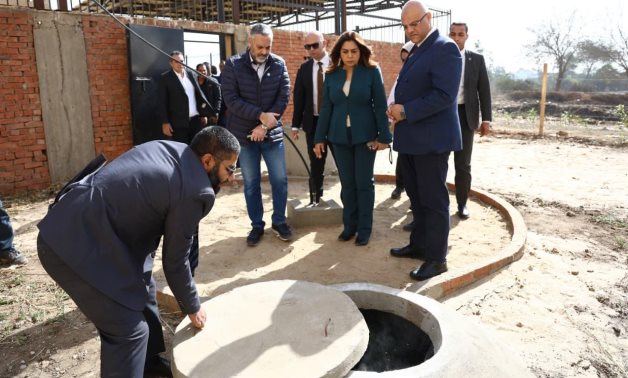
The Minister of Local Development and Environment Manal Awad inspected the biogas unit at the Kafr Shukr slaughterhouse in Qalyubia on February 15, 2026- press photo




CAIRO – 15 February 2026: The Minister of Local Development and Environment Manal Awad inspected the biogas unit at the Kafr Shukr slaughterhouse in Qalyubia, affirming the government’s commitment to maximizing the use of animal waste from slaughterhouses to produce organic fertilizer and renewable energy, preserve the environment, and support economic development.
Dr. Manal Awad stated that a medium-sized biogas unit model is being implemented at the Khanka slaughterhouse in Qalyubia. She also noted that a feasibility study is underway to establish a large-scale biogas plant in the New Valley at an estimated cost of EGP 13 million.
The Minister of Local Development and Environment announced that the first pilot biogas unit for collecting and recycling slaughterhouse waste was inspected at the semi-automated Kafr Shukr slaughterhouse in Qalyubia Governorate, following its official opening last Thursday.
The unit was established by the Bioenergy for Sustainable Development Foundation under the Ministry of Environment and represents the starting point for expanding small-, medium-, and large-scale biogas units across government slaughterhouses nationwide, the Minister said.
She emphasized that equipping slaughterhouses with biogas units and treatment plants for the first time reflects the Ministry’s commitment to supporting the green economy and positions the project as a pioneering environmental model.
Manal Awad explained that the small-scale unit at Kafr Shukr collects slaughterhouse waste and converts it into biogas and natural organic fertilizer. The fertilizer can be used in organic farming for export to markets that prohibit chemical fertilizers, aligning with Egypt’s strategy to boost exports, rationalize water use, and enhance the competitiveness of agricultural products.
She added that the project promotes the transfer and expansion of bioenergy technology in Egypt by addressing technical, institutional, and financial challenges. It also supports environmental and social development, creates job opportunities in the bioenergy sector, reduces financial burdens in certain areas, provides biogas as an alternative to butane for electricity generation, and supplies safe organic fertilizer as a substitute for chemical fertilizers.
The Minister further noted that a medium-sized biogas unit will be implemented at the Khanka slaughterhouse in Qalyubia to increase production capacity. A larger model is planned for the New Valley Governorate, supported by a completed feasibility study. This project will utilize waste from a 3,000-head cattle farm at an estimated cost of EGP 13 million and is expected to generate approximately EGP 17 million in its first year through the production of organic fertilizer and energy.

Be Social




Comments
Leave a Comment