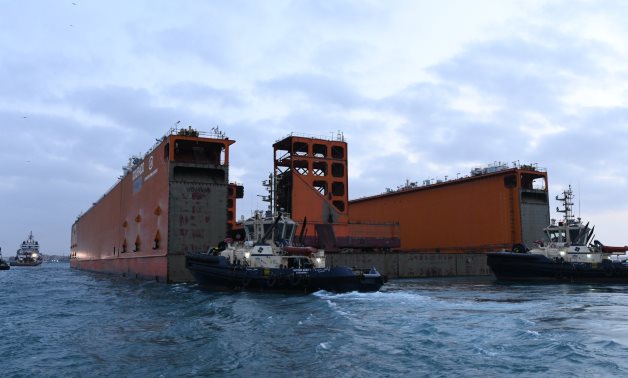
with a width of 90 meters, the giant floating dock “DOURADO,” has successfully sailed through the Suez Canal waterway




CAIRO - 3 February 2026: Hani Sewilam, Egypt’s Minister of Water Resources and Irrigation, held an extensive meeting with young leaders at the Maadi Olympic Center as part of the fourth edition of the Youth Diplomacy Program organized by the Ministry of Youth and Sports. During the event, the Minister discussed critical issues related to sustainable development, water resource management, and the pivotal role of youth in achieving environmental sustainability under Egypt Vision 2030.
He praised the efforts of Ashraf Sobhy, Minister of Youth and Sports, for preparing a conscious generation capable of addressing national challenges, particularly the water issue which directly impacts all citizens.
Sewilam delivered a lecture on the state’s massive efforts to achieve water security and the significant modernization currently underway under the second generation of the Egyptian water system, known as Water 2.0. He described the Nile River as a core file of Egyptian national security and emphasized that Egypt continues to support its fellow Nile Basin countries by implementing projects such as clearing waterways, constructing rainwater harvesting dams, drilling solar-powered wells, and establishing rain prediction centers.
The Minister reaffirmed Egypt’s steadfast policy regarding the Nile, which is based on absolute commitment to international laws governing shared international rivers. He stated that Egypt adopts dialogue and cooperation as a consistent approach to achieve mutual benefits among basin countries while maintaining that the Nile is a red line since the nation depends on it for 98 percent of its renewable water resources. He emphasized that the state will never compromise or forfeit a single drop of this vital resource.
Furthermore, Sewilam reviewed the pillars of the Water 2.0 strategy, which leverages modern technology, digital transformation, and mathematical models to optimize water management. This includes treating agricultural drainage water, developing decentralized treatment plants, and utilizing satellite imagery and drone photography for infrastructure monitoring.
The strategy also focuses on rehabilitating water structures, protecting coastal areas from climate change, and enhancing human resource capabilities through specialized training and public awareness campaigns. He concluded by highlighting Egypt’s successful international diplomacy in placing water at the top of the global climate agenda during its leadership of the African Ministers' Council on Water and the African Water Facility.

Be Social




Comments
Leave a Comment