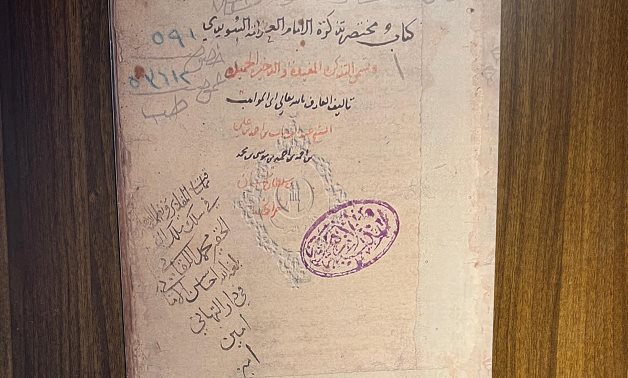
The manuscript, Mukhtasar Tadhkirat al-Suwaidi (al-Tadhkira al-Mufida wa al-Dhakhira al-Hamida)




CAIRO - 26 January 2026: The Al-Azhar Library Museum, located within the Al-Azhar Pavilion at the Cairo International Book Fair, preserves a remarkable intellectual heritage spanning numerous disciplines. Among its most valuable holdings is a scientific manuscript more than 450 years old, regarded as a rare treasure documenting the advancement of medical sciences in Islamic civilization.
The manuscript, Mukhtasar Tadhkirat al-Suwaidi (al-Tadhkira al-Mufida wa al-Dhakhira al-Hamida), is considered one of the most prominent classical references in traditional and alternative Arab medicine. The abridgment is attributed to Egyptian Imam Abd al-Wahhab ibn Ahmad ibn Ali al-Sha‘rani al-Hanafi (d. 973 AH), renowned for his efforts to simplify scientific knowledge and make it accessible to wider audiences.
He condensed the original work, Tadhkirat al-Suwaidi, authored by the distinguished physician Ibrahim ibn Muhammad ibn Abi Bakr al-Suwaidi al-Ansari, a leading medical authority of his era and compiler of major medical encyclopedias.
The manuscript holds exceptional historical and scientific significance. It bears ownership inscriptions belonging to Ali al-Nuri and Muhammad al-Laqqani, and its transcription dates back to 987 AH. This makes it a living testament to the circulation and reliability of medical knowledge over more than four and a half centuries, reflecting its enduring status among scholars and physicians.
Structurally, the book demonstrates a clear and systematic scientific methodology and is divided into three main sections. The first addresses simple medicines, arranged alphabetically, detailing plants, minerals, and animal substances along with their properties and therapeutic uses. The second section focuses on compound medicines, outlining methods for preparing drugs, syrups, pastes, and ointments in accordance with established pharmacological principles. The third section is dedicated to the treatment of diseases, organized from head to toe, and includes ailments of the eyes, chest, stomach, and skin, as well as examples of minor surgical procedures.
The manuscript’s scientific value lies in its integration of Prophetic medicine, botanical knowledge, and practical medical experience. It reflects an early awareness of the importance of systematically organizing medical knowledge, moving beyond random or unsystematic approaches. As such, it remains an invaluable resource for researchers studying the history of medicine and science.
“The presentation of this manuscript today underscores the depth of Islamic scientific heritage and its foundational role in establishing sound scientific methodologies. Al-Suwaidi’s abridged treatise stands as a lasting testament to the contributions of Muslim scholars in advancing human health and serving humanity across the ages,” Al Azhar said in a statement on Monday.
For the tenth consecutive year, Al-Azhar is participating with a dedicated pavilion at the 57th Cairo International Book Fair, held from January 21 to February 3, 2026, at the Egypt International Exhibition Center in New Cairo. The pavilion spans approximately 1,000 square meters and is located in Heritage Hall No. 4.

Be Social




Comments
Leave a Comment