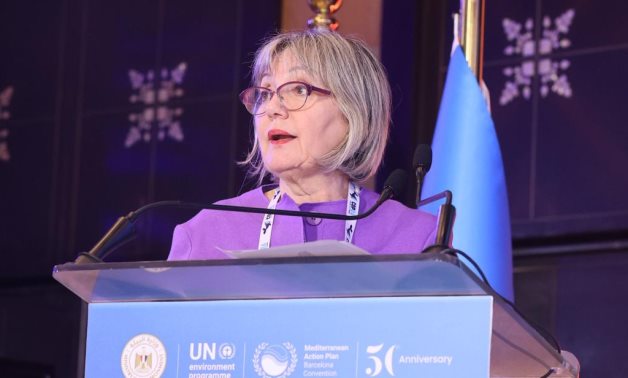
Tatjana Hema, Coordinator of the United Nations Environment Programme’s Mediterranean Action Plan (UNEP/MAP) gives a speech at the COP 24 meeting in Cairo- press photo




CAIRO – 13 December 2025: Tatjana Hema, Coordinator of the United Nations Environment Programme’s Mediterranean Action Plan (UNEP/MAP), called for intensified and accelerated efforts to protect marine life in the Mediterranean Sea, as part of the agenda of the 24th Conference of the Parties to the Convention for the Protection of the Mediterranean Environment against Pollution (Barcelona Convention COP24).
In an interview with Egypt Today on the sidelines of the COP24 meetings held in Cairo from December 2 to 5, Hema emphasized the need to move beyond commitments toward tangible implementation.
“As for realistic progress that COP24 can achieve for the Mediterranean, not only in terms of commitments but also implementation; this is exactly what we aim for,” Hema said. “As you may have heard from the discussions and ministerial statements, many implementation measures are already in place. But we must do better and do more. I am confident that this COP has sent a strong message: the time has come not only for action, but for accelerated action.”
Addressing efforts to combat illegal fishing in Mediterranean countries, Hema noted that while progress is being made, further improvement is still needed.
“I cannot say definitively whether enough is being done, but a significant effort is underway,” she said. “The Barcelona Convention does not directly address illegal fishing. We issue political declarations, but another organization in the Mediterranean, the General Fisheries Commission for the Mediterranean and the Black Sea (GFCM), supports countries in ensuring that illegal fishing does not occur. There is progress, but there is always room for improvement.”
On the availability of new financing mechanisms or climate funds dedicated to Mediterranean coastal and marine protection, Hema explained that the Barcelona Convention mobilizes resources to support countries in addressing climate change and in establishing and effectively managing Marine Protected Areas (MPAs).
She highlighted the MedFund, a financing mechanism dedicated to MPAs, supported by the Government of Tunisia, the Prince Albert II Foundation of Monaco, and the Government of France. The fund plays a key role in advancing marine protection efforts across the region.
Additionally, Hema noted that a fund established under the Convention on Biological Diversity (CBD) supports the implementation of the Global Biodiversity Framework’s 30x30 target, which aims to protect 30 percent of the world’s marine areas by 2030.
“We are communicating with countries to identify how they can benefit from this,” she said. “Egypt is working with UNDP, and other Mediterranean countries are also interested in collaborating with us to secure additional resources.”
Commenting on the funding gap facing the Mediterranean Action Plan, Hema acknowledged that financial challenges remain, given the scale of commitments under the Barcelona Convention.
“Countries are obliged to build wastewater treatment plants in all coastal cities, develop and manage sustainable landfills, dispose of obsolete chemicals in an environmentally sound manner, prevent plastic pollution, and ensure the sea is not contaminated by marine litter,” she said. “All of this requires significant investment.”
Hema explained that UNEP/MAP works to mobilize resources from mechanisms such as the Global Environment Facility (GEF), as well as regional development banks including the European Bank for Reconstruction and Development (EBRD), the European Investment Bank (EIB), and potentially the Arab Development Bank.
“Most importantly, we support countries in developing national policies, identifying potential projects, and preparing those projects to attract financing for implementation,” she said. “This is a long-term effort that requires strong commitment, and we are working to ensure countries move in the right direction.”

Be Social




Comments
Leave a Comment