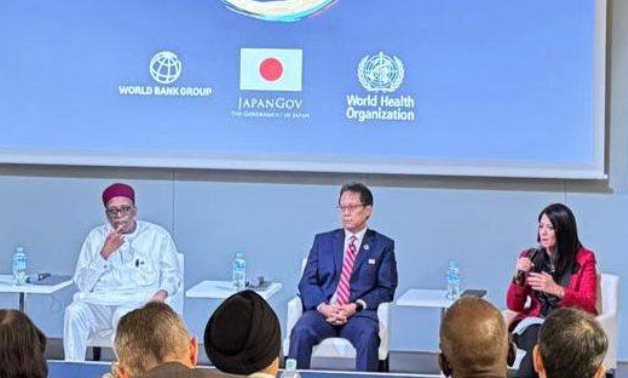
Egyptian Minister Planning, Economic Development and International Cooperation Rania Al-Mashat participated in Universal Health Coverage (UHC) High-level Forum in Tokyo, on Sunday.




CAIRO – 7 December 2025: Egyptian Minister Planning, Economic Development and International Cooperation Rania Al-Mashat participated in Universal Health Coverage (UHC) High-level Forum in Tokyo, on Sunday.
The forum, which was organized by the Government of Japan in collaboration with the World Health Organization (WHO) and the World Bank Group, was held in Tokyo with the participation of senior officials from governments and international institutions.
The forum witnessed the launch of the Universal Health Coverage Knowledge Hub, an innovative platform developed by the Government of Japan, the World Bank, and the WHO to promote knowledge exchange and support national healthcare policies. Participating countries include Egypt, Nigeria, the Philippines, Kenya, Indonesia, Ghana, Cambodia, and Ethiopia.
In her address, Dr. Al-Mashat underscored Egypt’s belief that healthcare is both a fundamental right and an economic imperative, forming the basis of productivity, job creation, and inclusive, sustainable growth. She noted that while the world committed in 2015 to achieving universal health coverage by 2030, Egypt views this goal not merely as an aspiration but as a national strategy focused on investing in human capital, the strongest driver of sustainable development.
Dr. Al-Mashat highlighted that Egypt has translated this commitment into tangible action. Over the past five years, national spending on the health sector has nearly quadrupled, enabling the alignment of health objectives with development priorities, improving service efficiency, and strengthening efforts to enhance citizens’ quality of life.
She reaffirmed that Egypt aims to achieve full coverage under the Comprehensive Health Insurance System by 2030—a goal that requires advanced technical capacities, efficient operational systems, and sustainable financing to ensure consistent and effective nationwide implementation.
She noted that achieving universal health coverage extends beyond expanding service provision to strengthening sustainability and maximizing value. In this context, Egypt is implementing a strategic transformation in health financing to enhance the efficiency of public resource allocation and expand equitable access to quality services.
Reviewing the Egyptian experience, she affirmed that the health sector remains a top national priority, not only as part of the social protection network but as a fundamental pillar of comprehensive development.
This commitment is reflected in major initiatives, including the implementation of the Comprehensive Health Insurance System in cooperation with the World Bank and other development partners, as well as numerous presidential initiatives that have significantly expanded healthcare services nationwide, the Minister added.
Dr. Al-Mashat highlighted that the first phase of the Comprehensive Health Insurance System covers six governorates, benefiting 5.1 million citizens, with investments of approximately EGP 28.5 billion from 2018 to 2025. The second phase covers five governorates and benefits 12.4 million citizens, supported by EGP 20 billion allocated for healthcare facility development. In addition, concessional financing totaling $880 million has been provided by development partners—including the World Bank, the French Development Agency (AFD), and the Japan International Cooperation Agency (JICA)—to support the system’s implementation.
She also commended the contributions of the International Finance Corporation (IFC) and AFD in supporting private sector engagement, policy reform, and institutional capacity-building—efforts that bolster the resilience and efficiency of the healthcare system.
She noted that the presidential health initiatives have reached approximately 90 million citizens, delivering more than 250 million services, including early detection campaigns, screenings for non-communicable diseases, and follow-up and treatment programs.
Regarding the Decent Life initiative, Dr. Al-Mashat highlighted that more than 2,000 primary healthcare units have been established or upgraded, significantly improving healthcare service quality in rural areas and easing the burden on central and general hospitals. She emphasized that this progress reflects not only the scale of national efforts but also the strong integration among various initiatives under a unified national vision.
The Minister highlighted Egypt’s success in eliminating the hepatitis C virus, noting that the World Health Organization has officially declared Egypt free of the disease. This achievement was made possible through large-scale testing and treatment campaigns, as well as the local production of medication by private-sector companies—demonstrating the essential roles played by government, the private sector, and international partners in the healthcare system.

Be Social




Comments
Leave a Comment