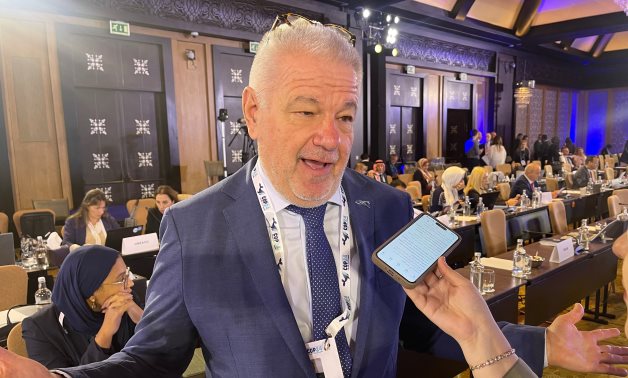
President of COP 23 Meetings of Barcelona Convention Mitja Bricelj is interviewed on the sidelines of the COP 24 meetings in Cairo on December 4, 2025- Egypt Today/ Samar Samir




CAIRO – 6 December 2025: As Mediterranean countries gather once again in the 24th Meeting of the Contracting Parties to the Barcelona Convention and its Protocols (COP24), held in Cairo, to discuss the future of their shared marine environment, Mitja Bricelj, President of the 23rd Meeting of the Contracting Parties (COP23) and representative of Slovenia, emphasized that the time has come to move beyond commitments on paper and adopt concrete, community-driven, and cross-border action.
In an interview with Egypt Today on the sidelines of the COP 24 meetings, Bricelj said that the Mediterranean faces a widening gap between ambitious declarations and the reality at sea, a gap that will continue to grow unless governments act urgently and collaboratively.
He explained that for Mediterranean states to reinforce their commitments, two parallel paths must be pursued. The first begins at home: governments must engage directly with local communities and the users of coastal areas to understand their concerns, needs, and practices.
The second path is transboundary cooperation. Since Mediterranean ecosystems are shared, no country can tackle pollution, overfishing, or habitat degradation on its own. He noted that it vital to “bring neighboring countries to the same level of understanding and action with caring about common and share ecosystem of marine and coastal environment.” These two principles, which is bottom-up engagement and top-down cooperation, must become the backbone of Mediterranean environmental governance, he stressed.
Lessons From Slovenia
Drawing on Slovenia’s experience, highlighted several policies that could be replicated across the Mediterranean. Slovenia, he said, has long prioritized dialogue with national stakeholders and strengthened coordination with neighboring countries in the Adriatic Sea.
Through the European Adriatic–Ionian Strategy (EUSAIR), Slovenia launched cross-border projects covering marine protected areas, contingency planning, and marine spatial planning. “These practical, cooperative initiatives help governments and economies work hand in hand with their neighbors, [and secure] the funding needed [to do so],” he explained.
Why overfishing efforts have fallen short
Despite decades of conferences, action plans, and regional commitments, overfishing remains one of the gravest ecological threats in the Mediterranean. Dr. Mitja Bricelj acknowledged that the problem is widely recognized, but he emphasized that identifying the obstacles is equally important.
“This is a real problem, and we all know it,” he said. “But we also know who is breaking the agreements,” He warned that a handful of “big players” repeatedly undermine regional fisheries commitments, causing economic and ecological damage. “This must be addressed transparently,” he urged. “We cannot hide behind the curtains while national economies suffer.”
Closing the gap between words and action
Asked what immediate measures Mediterranean countries must adopt to prevent the collapse of commercial species and marine biodiversity, Dr. Bricelj pointed to a critical challenge: the widening gap between promises made at conferences and the slow pace of actual implementation.
“This is the central question,” he said, noting that the gap will only be closed if politicians face the urgency, and if civil society insists on action.
“It's on the politicians, of course- but we know how politicians were extremely important to civil society to take care and to exist. This is essential for them to survive, for their children, for the new generation. This is something what we need to raise our voice,” he said.
He added that across Europe and the Mediterranean, the pattern is the same: “Nice words, nice papers but weak implementation.” The only way forward, he said, is for communities to push their leaders to make improvement and pinpoints the problems that should be addressed.
“We must put our finger in the gap and tell presidents, mayors, and leaders: ‘We are here, and we need you to work together. We are suffering from [the consequences.]”
He described this as both a right and an obligation, particularly for parents who envision a safer, more resilient environment for their children. “This is really a bottom-up and top-down process,” he said.
The solution, he concluded, lies in political will and education: “We must raise awareness among the next generations.” Education is essential to show where the gaps are and how to move forward without causing new damage, he noted.
Funding: Not a question of money, but allocation
Commenting on the availability of funds, Dr. Mitja Bricelj emphasized that many international projects already support stakeholder dialogue and the shift toward a sustainable blue economy. The challenge, however, is not the lack of resources but their allocation.
“Projects help, of course, but sustainability must become mainstream,” he said. “From my perspective, it’s not a lack of money. There is enough money; the question is whether it is allocated to the right things.”
He called investments in environmental protection “the best investment in the future,” stressing that sustainability is something that cannot simply be bought. Instead, it must be nurtured and passed on to future generations.
Each country’s coastline, he added, is unique and requires a tailor-made approach. Every coast is not France’s coast or Italy’s coast, he said. Every nation must respect its local conditions, values, and identity, he continued.
This includes choosing appropriate forms of tourism, perhaps more modest, lower-impact models that ensure a better quality of life. “That is the point,” he concluded.

Be Social




Comments
Leave a Comment