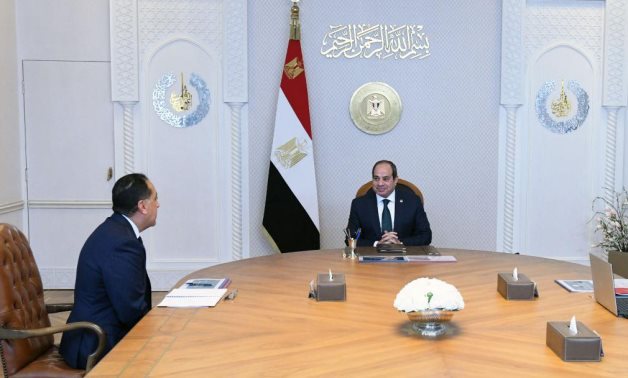
President Abdel Fattah El-Sisi met with Prime Minister Dr. Mostafa Madbouly, and Minister of Education and Technical Education Mr. Mohamed Abdel Latif.




CAIRO – 6 December 2025: President Abdel Fattah El-Sisi has directed that the number of Japanese schools in Egypt be increased to 500 within the next five years, the Presidency announced in a statement on Saturday.
The directives came during a meeting with Prime Minister Dr. Mostafa Madbouly and Minister of Education and Technical Education Mr. Mohamed Abdel Latif.
During the meeting, the Minister of Education presented the implementation progress of introducing Programming and Artificial Intelligence (AI) into the first-year secondary curriculum beginning in the 2025/2026 academic year. He emphasized that the integration of this subject aligns with the State’s vision for digital transformation and educational development, responding to the demands of the technological revolution and its impact on the labor market.
The Minister noted that demand for the Japanese “QUREO” Programming and AI platform has exceeded expectations, with more than 236,000 students completing the full training content. He added that secondary school students who study the subject receive an internationally accredited programming certificate from Hiroshima University in Japan. The minister also announced that Programming and AI will be introduced into Technical Education starting in the 2026/2027 academic year.
The meeting further reviewed the Ministry of Education’s efforts to advance the technical education system through expanding Applied Technology Schools, which reached 115 schools in the 2025/2026 academic year. These schools link academic study with practical training through private sector partnerships. International agreements have also been signed to provide graduates with accredited certificates, helping them access job opportunities both locally and internationally. President El-Sisi stressed the importance of maximizing efforts to improve the scientific and professional standards of technical education graduates to meet the growing needs of the labor market.
The Minister also shared the outcomes of his field visits to monitor the educational process across various governorates. He highlighted the Ministry’s progress in resolving longstanding challenges, including eliminating shortages of teachers in core subjects, reducing classroom density to below 50 students, and ensuring the timely distribution of textbooks.
Additionally, the Minister reviewed the latest developments in implementing the Egyptian Baccalaureate Certificate system. He explained that the system offers multiple exam opportunities and diverse tracks suited to students’ aptitudes and abilities, effectively ending the traditional single-chance general secondary exam model. He noted the growing interest in the Egyptian Baccalaureate, with enrollment exceeding 90% of first-year secondary students this academic year.
President El-Sisi emphasized the need for strict measures against exam cheating and directed that penalties be intensified for individuals found guilty of involvement in General Secondary examination violations.
The President also instructed that continuous efforts be made to support teachers by providing sustained incentives and improving their economic conditions. He reaffirmed the importance of maintaining discipline and promoting positive values throughout the educational system, stressing zero tolerance for misconduct and the necessity of swift and decisive accountability for any violations.

Be Social




Comments
Leave a Comment