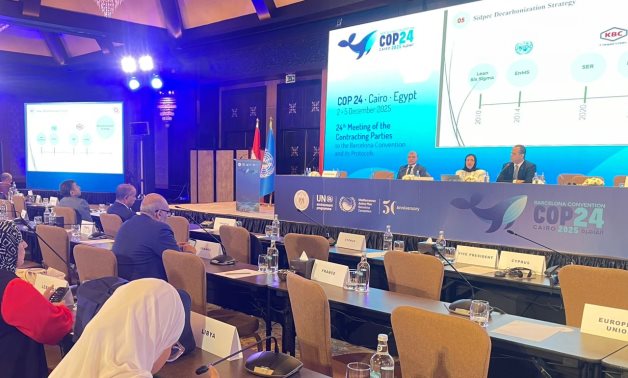
A side event for the Cop 24 - Barcelona Convention in Cairo on December 2, 2025- Press photo




CAIRO – 2 December 2025: On the sidelines of the COP24 - Barcelona Convention, which is being held in Cairo for four days, several side events have been organized to address a range of shared concerns among member states regarding the threats facing the Mediterranean Sea.
Egypt officially assumed the presidency of the 24th Meeting of the Contracting Parties to the Barcelona Convention and its Protocols (COP24) on Monday, for a two-year term.
The handover ceremony took place in Cairo with the participation of ministers and representatives from 21 Mediterranean countries, as well as regional and international organizations.
Focus on climate change and plastic pollution
Side events at COP24 of the Barcelona Convention opened with discussions on climate change and plastic pollution, which are considered two of the most urgent environmental threats facing the Mediterranean region.
The first session, “The Carbon Budget for the Mediterranean Region,” organized by OceanCare, highlighted findings from a new report by the Basque Center for Climate Change (BC3). The report shows that the Mediterranean is a global climate hotspot—warming faster than nearly any other region except the Arctic. It warns that, at current emission levels, the region’s remaining carbon budget will be depleted by 2035, requiring Mediterranean countries to cut emissions by 65% annually from 2030 to 2050 to remain within safe climate limits. The report urges immediate emissions reductions, an end to fossil fuel expansion, and stronger regional cooperation under the Barcelona Convention.
A second panel, “Towards a Mediterranean Protocol on Plastics,” focused on addressing plastic pollution and its severe impacts on marine ecosystems. Experts emphasized the role of communities, civil society, and youth in reducing single-use plastics and improving waste segregation and management. The session also discussed ongoing initiatives and a proposal for a new Mediterranean Protocol on Plastics, aimed at creating a regulatory framework to prevent, manage, and eliminate plastic pollution, strengthen the Barcelona Convention, and establish strong commitments from Mediterranean countries.
More side-events for COP 24
On the sidelines of COP24 of the Barcelona Convention, which is hosted by Egypt, several specialized discussion sessions were held focusing on underwater cultural heritage, regional cooperation to prevent pollution from ships in the Mediterranean, and the decommissioning of oil and gas platforms.
The first session explored Egypt’s underwater cultural heritage and its role in achieving the Sustainable Development Goals, highlighting a case study on establishing an integrated underwater heritage center at Qaitbay Citadel. Experts discussed the challenges facing submerged heritage sites and the importance of improving marine water quality, an effort supported by national projects that have reduced pollution and enhanced visibility, helping position Alexandria as a global destination for underwater tourism.
The second session addressed efforts to prevent pollution from ships in the Mediterranean. Italy’s Regional Center for Emergency Response to Marine Pollution presented studies emphasizing the importance of international cooperation, adherence to maritime pollution agreements such as “the International Convention for the Prevention of Pollution from Ships” (MARPOL), improvements in ship fuel quality, and enhanced safety procedures. The session underscored the need for training, infrastructure development, and joint action plans to strengthen regional response capabilities.
The third session focused on the decommissioning of oil and gas platforms. The International Association of Oil and Gas Producers highlighted the complexity of the process and the need for strong legislative and environmental frameworks. The presentation emphasized circular economy approaches, such as repurposing, reuse, and recycling, which reduce environmental impact, extend asset life, decrease carbon footprints, and increase resource efficiency.
Carbon neutrality, controlling exhaust fumes from ships
Also, during the first day of COP24 of the Barcelona Convention, Sidi Kerir Petrochemicals Company (SIDPEC), the conference’s official sponsor, organized a side event highlighting its strategies for carbon neutrality, circular economy solutions, and environmental sustainability.
Company representatives presented SIDPEC’s efforts to reduce emissions, improve energy efficiency, comply with national and international environmental standards, and contribute to a healthier Mediterranean. These efforts include cooperation with the Industrial Pollution Control Project, securing environmental approvals for seven projects, linking to national air and wastewater monitoring networks, and implementing operational improvements to support long-term sustainability goals.
SIDPEC also promotes circular economy practices, prepares studies on plastic recycling and pollution reduction, and has designated its polyethylene products as environmentally friendly. The company aims to cut greenhouse gas emissions by 17.8% and plans to issue a periodic sustainability report by 2027 to enhance transparency.
A European civil society organization also held a side event titled “Transforming the Mediterranean into a Safer Region,” which focused on regional cooperation to prevent pollution from ships.
The session highlighted French practices for controlling exhaust fumes from ships, measures that protect air quality but can cause water pollution if untreated. France presented its approach as a model for the Mediterranean and called on the IMO and Barcelona Convention Parties to adopt stricter regulations, including banning fume flaring in inland waters and ports.
The discussion emphasized the urgency of these measures ahead of the implementation of the Mediterranean Climate Change Agreement (Med SECA) in 2025, which could lead to increased use of fume-flaring systems. The event also addressed ways shipowners and shipping companies can support these measures and referenced Egypt’s related efforts through the Suez Canal.
Others side-events
The IUCN Mediterranean Cooperation Centre (IUCN MED), with regional partners, discussed a technical and scientific support mechanism to implement the Global Biodiversity Framework, focusing on regional centers’ roles in policy planning and assisting Barcelona Convention implementation.
The Mediterranean Wetlands Observatory presented its Wetlands Outlook, emphasizing wetlands’ role in biodiversity, climate resilience, and sustainable management, while offering recommendations for policymakers and conservation stakeholders.
A session on “Innovation and Technology for Marine Biodiversity and the Blue Economy” stressed that oceans face biodiversity loss and climate impacts, threatening ecosystems and livelihoods. Discussions focused on emerging technologies, translating data into actionable insights, and investment policies to scale solutions for marine sustainability.

Be Social




Comments
Leave a Comment