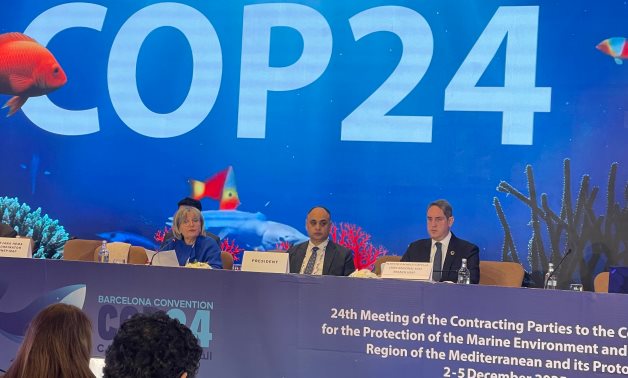
Egypt officially assumed the presidency of the 24th Meeting of the Contracting Parties to the Barcelona Convention and its Protocols (COP24) on December 2, 2025- Egypt Today/ Samar Samir




CAIRO – 2 December 2025: Egypt officially assumed the presidency of the 24th Meeting of the Contracting Parties to the Barcelona Convention and its Protocols (COP24) on Monday, for a two-year term.
Mitja Bricelj, President of the 23rd Meeting of the Contracting Parties (COP23) and representative of Slovenia, handed over the presidency of COP24 to Ali Abo Sena, CEO of the Egyptian Environmental Affairs Agency and Assistant Minister of Environment for Projects.
The handover ceremony took place in Cairo with the participation of ministers and representatives from 21 Mediterranean countries, as well as regional and international organizations.
Manal Awad, Egyptian Minister of Local Development and Acting Minister of Environment, stated that Egypt’s presidency of COP24 reflects the Mediterranean community’s confidence in its active role in addressing environmental challenges.
She added that the conference provides an opportunity to strengthen cooperation and partnerships aimed at protecting the Mediterranean environment and advancing the green transition.
Awad highlighted Egypt’s ongoing efforts to protect the marine environment and support the national blue economy, emphasizing that the marine ecosystem is a lifeline for millions and a core pillar of the country’s development path.
“Egypt’s coastline stretches more than 3,000 kilometers along the Mediterranean and Red Seas, forming a lifeline and providing essential resources—food, energy, tourism, and trade. Millions of Egyptians depend on marine resources for their daily livelihoods, from marine fisheries to ecotourism, maritime transport, and blue energy,” she said.
She noted that Egypt’s coastal zones represent a critical intersection of fragile ecosystems and dense economic activity, making integrated coastal management not optional but a strategic necessity.
Awad explained that Egypt is developing its first Integrated National Strategy for the Blue Economy, and is leading efforts to adopt the Cairo Declaration, which reaffirms regional commitment to accelerating the transition toward a sustainable blue economy.
“We view the blue economy not merely as an environmental concept, but as a new economic model capable of achieving sustainable growth, creating decent jobs, enhancing food security, and protecting marine biodiversity,” she added.
COP24 of the Barcelona Convention is being held under the theme: “A Sustainable Blue Economy for a Resilient and Healthy Mediterranean Sea.”
Awad expressed hope that the coming days would witness discussions and adoption of key decisions shaping Mediterranean cooperation for the next decade, including the updated Mediterranean Strategy for Sustainable Development (2026–2035), the regional framework for climate-change adaptation in marine and coastal areas, the updated Mediterranean Action Plan for environmental monitoring and assessment, and the Cairo Ministerial Declaration—led by Egypt as a unified document reflecting collective commitment to a sustainable and inclusive blue economy.
Issues to be addressed during the four-day conference
For his part, Mitja Bricelj, President of COP23 and representative of Slovenia, stressed the importance of preserving the long-standing cooperation among Contracting Parties to the Barcelona Convention, a partnership spanning over half a century and connecting three continents: Africa, Asia, and Europe.
He noted that the four-day conference will address several important topics, including the updated Mediterranean Strategy for Sustainable Development 2026–2035, the regional framework for climate-change adaptation 2026–2035, and the revised ecosystem-based approach policy and roadmap for the Mediterranean. These discussions aim to reduce pressures on marine ecosystems and ensure a brighter future for the region.
Meanwhile, Tatjana Hema, UNEP Coordinator for the Mediterranean Action Plan and the Barcelona Convention, affirmed that the Mediterranean region has undergone significant changes in recent years and is suffering from pollution and biodiversity loss—challenges that require swift solutions to secure a sustainable future and economy for the region. Solutions, she noted, must effectively address climate change and plastic pollution.
She praised the achievements of the Contracting Parties over the past 50 years, made possible through cooperation and solidarity. She expressed anticipation for the decisions expected from COP24, which aim to advance efforts toward cleaner coastlines and define future work mechanisms that will pave the way for greater progress and sustainability.
Hema also emphasized the importance of continued cooperation and thanked the government and people of Egypt for their warm hospitality, coordination, and collaboration from the heart of historic Cairo. She congratulated Egypt—“the Mother of the World”—on the opening of the Grand Egyptian Museum, calling it a global landmark that reflects the grandeur of ancient Egyptian civilization.
Temperature of Mediterranean Sea is rising 20% faster than the global averag
Alberto Pacheco Capela, Head of the Regional Seas Unit at UNEP, expressed his gratitude for Egypt’s leadership and excellent hosting of the conference.
He explained that the meeting of Contracting Parties aims to confront the pressing challenges facing the Mediterranean Sea, whose temperature is rising 20% faster than the global average. He said the Mediterranean has become a catalyst for countries to recognize these threats and respond through cooperation, an approach that gave rise to the Barcelona Convention, now the central framework guiding the region’s environmental future.
He emphasized that COP24 is taking place at a critical moment, building on the Mediterranean Action Plan’s efforts to link science and technology, which have enhanced decision-making and cooperation among Mediterranean countries. He added that the conference presents an opportunity to deepen joint action and strengthen governance in areas beyond national jurisdiction.
Egypt’s plan for the two-year presidency
COP 24 President-designate Ali Abo Sena said that the Egyptian Presidency is a significant asset that can be leveraged to enhance technical and technological cooperation in addressing urgent environmental challenges along the coasts.
He added that the Egyptian Environmental Affairs Agency is currently developing a comprehensive priority plan for the Egyptian presidency, which includes identifying critical projects and opening negotiation channels with the European Union, the largest funder of marine environmental programs in the region.
Abo Sena explained that the plan aims to attract development financing for coastal protection projects and accelerate the transition of Egyptian ports into green ports, while ensuring the necessary technical support to implement these programs in line with international standards.
He added that protecting the marine environment directly contributes to strengthening the national economy and enhancing Egypt’s competitiveness within the Mediterranean maritime trade system.
Abu Sena also outlined Egypt’s top priorities for the coming period, which include reducing plastic leakage into the sea, developing effective waste management programs, combating all forms of marine pollution, whether from operational activities or accidents, besides advancing a program to transform Egyptian ports into green ports, a central component of the negotiation strategy.

Be Social



Comments
Leave a Comment