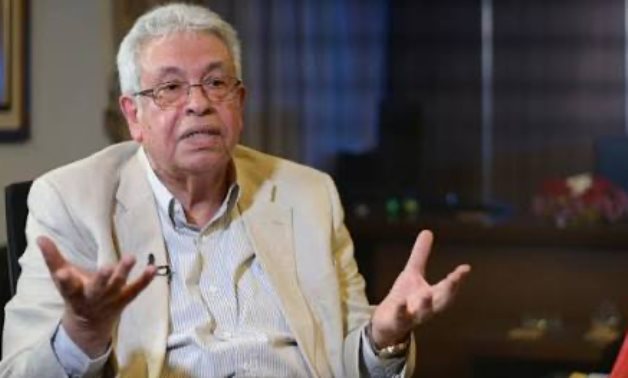
Abdel Moneim Said




CAIRO - 28 November 2025: Dr. Abdel Moneim Said, a prominent political analyst, said that U.S. President Donald Trump's process to designate the Muslim Brotherhood (MB) as a terrorist organization signifies that the fight against the MB will become part of the larger war on terror.
In an interview with Egypt Today, the veteran analyst said such a move would entail locating the group's activity centers globally. Consequently, research centers and universities would align their work for this purpose.
Following that, all of the group's economic lifelines would be severed. This would involve extensive intelligence activity to track the group's means for transferring weapons to organizations like Hamas and others, and the tactics it employs to recruit followers within Western societies.
Said added that the measures resulting from Trump’s designating the MB as a terrorist organization would be a major undertaking, given that it is a global organization with an international framework. Thus, there would be a sort of "hunt" to thwart the group's political, military, and ideological activities.
The Egyptian analyst predicts cooperation between the U.S. and Arab and Islamic countries that have already classified the MB as a terrorist group, such as Egypt, Saudi Arabia, and the UAE.
However, Said warned that the MB has a capacity for self-renewal and can quickly withdraw.
He said the core of this issue is arguably the Hamas movement, considering that some believe it is obstructing the U.S. President's peace initiative in the Middle East. Hamas's refusal to disarm, he argued, sets an example for other organizations the U.S. classifies as terrorist, such as Hezbollah, the Houthis, and the Popular Mobilization Forces in Iraq—organizations that threaten the stability of their nations and usurp the state's authority in the countries where they exist.
The militarized presence of such groups warn of civil war, he stressed, adding that no true state can tolerate armed organizations operating outside the framework of the state's legitimate authority.
Responding to a question about the status of Brotherhood-affiliated organizations within the United States, such as CAIR and others, he affirmed that CAIR might make concessions, but some matters within the U.S. could require judicial intervention, such as CAIR filing a lawsuit against the government.
Ultimately, however, it will find itself under immense pressure, as the significant donations it receives from Muslims in America—given its status as an American civil society organization—would cease. He noted that all these matters would be clearly defined after the decision is announced.
Said further elaborated, "The Brotherhood is a terrorist group, and even if it is not, it nurtures terrorist groups. Most terrorist groups, from Al-Qaeda to ISIS, were raised in the Brotherhood's incubator."
He also noted that most of the Anglo-Saxon world previously held a specific view toward the group.
“Britain always saw the Muslim Brotherhood as an important window for penetrating many societies, in exchange for the freedoms it granted the group on its soil,” he said.
He also pointed out that many Western countries were repeating Britain's experience with the group, making it part of the Anglo-Saxon tradition since the 1940s.
He concluded, "These countries viewed the Brotherhood, since its emergence, as the 'sponge' that absorbs the more extremist organizations... This theory was reinforced after the appearance of Al-Qaeda, ISIS, and the more extremist groups that created a space and a difference between themselves and the MB. But now, it is clear that there is a review of these matters across the entire Western sphere."
On Monday, U.S. President Donald Trump took the first step of naming the Muslim Beothehood a terrorist organization on Monday by ordering the Secretary of State and the Treasury Secretary to submit a report on whether the Islamist group should be listed as such.
Trump signed an executive order whereby Secretary of State Marco Rubio and Treasury Secretary Scott Bessent write a report on whether to designate certain the Muslim Brotherhood chapters as foreign terrorist organizations and specially designated global terrorists.
The two secretaries will designate the Muslim Brotherhood chapters on which they decide in 45 days of submitting the report.
According to a White House statement, examples of the chapters include the Muslim Brotherhood in Egypt, Lebanon, and Jordan.
Europe and the Muslim Brotherhood
Although the U.K. in 2015 was one of the first Western countries to release a report on the MB and its plans for British Muslims in particular and the British society in general, it has failed to acknowledge the report by any meaningful action for 10 years now.
France issued a similar report in May 2025 to find that the Islamist group is a “threat to national cohesion.”
Unlike the British report, the French one found a reaction, where President Emmanuel Macron asked the government to come up with proposals to counter the facts found in the report, dubbing the findings “serious.”
The French report said the MB has led to “the creation of increasingly numerous Islamist ecosystems,” and with a “bottom-up” strategy, it aims to alter rules and values and affect local politics.
The British report found similar results, stating that the Muslims Brotherhood’s discourse is moderate in public, but radical in private, and that the “secretive” organization threats democratic values.
For its part, the French report said that the radical group has lost its influence in the Arab world and has since shifted its efforts to Europe.
Only two years prior to the release of the British report, a revolution ousted the rule of the Muslim Brotherhood in Egypt in 2013, after it became clear how the Muslims brotherhood used democracy to ultimately dismantle it, all in the name of a religion they attempt to hijack.
The overthrow that was met by brutal terrorist attacks in the country for several years. Both the hegemonic actions of the group before 2013 and the terrorist attacks after that exposed the Muslim brotherhood to Arab nations, losing much of the popularity it cultivated for many decades.

Be Social



Comments
Leave a Comment