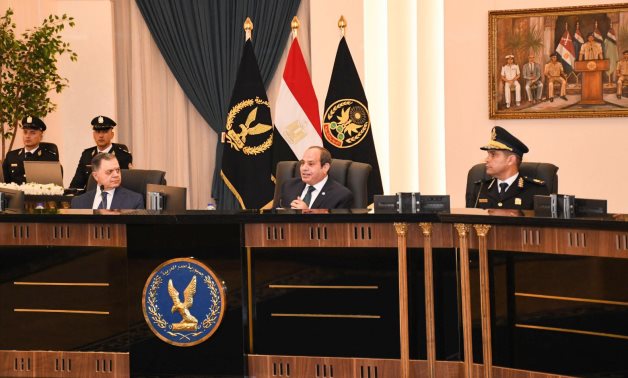




CAIRO - 18 November 2025: Egypt’s President Abdel Fattah El Sisi said Egypt is facing major challenges at various levels, stressing the need for collective efforts to achieve development and economic growth.
During his visit to the Police Academy on Tuesday, he told a group of the academy's applicants that hard work and strong commitment ensure high-quality performance across all sectors.
He said that true awareness means understanding life’s demands, overcoming challenges and avoiding negative influences.
True awareness includes all aspects of life—from social media to daily habits and spiritual life, he noted.
When citizens reach full awareness, they will be able to forge ahead on a solid path toward sustainable development and economic growth, the president said, noting that conscientious, productive work by all Egyptians is key to achieving future progress amid current regional and global challenges.
President Sisi said elections are the people’s way of choosing who represents them, warning that an electoral vote should never be exchanged for money or goods.
He said accepting payment to vote for an unfit candidate endangers the country by empowering someone who does not deserve the post.
He emphasized the importance of choosing honest, loyal and educated candidates, noting that selecting an unqualified person could affect the future of over 120 million Egyptians.
Sisi urged citizens to examine candidates carefully in all elections and to treat their vote as a national responsibility.
The president added that awareness is a broad concept that includes understanding national, social and personal issues.
President Sisi said managing personal finances helps citizens understand the national economy, noting that Egypt had no debts before 1970, and borrowing began in the aftermath of the 1967 war to meet the state’s needs.
Since the 1970s, government spending has expanded while financial resources were sometimes insufficient; leading to borrowing to cover the gap, Sisi added.
Reducing public debt, he said, requires a collective will and broad public awareness—especially regarding subsidy policies and pricing.
Cutting fuel subsidies, for example, aims to control debt, not increase burdens, the president noted.
Sisi stated that Egypt manages its internal and external debt transparently, pays interest regularly, and relies on balanced financial planning to maintain economic stability.
Responding to a question on the support provided for vulnerable groups, President Sisi said subsidies are important but make economic recovery difficult, stressing the need for public awareness of their true cost.
He explained that a gas cylinder cost the state EGP 350 two years ago when it was sold for EGP 100, meaning a 250-pound subsidy per cylinder.
With annual consumption reaching up to 300 million cylinders, the cost was about EGP 30 billion in subsidies, he said.
He noted that total subsidies for fuels, bread, food supplies, electricity, and other services amount to around EGP 600 billion.
Although the reforms are tough, they are the only way to overcome poverty and debts, the president said.
Sisi warned against misleading narratives that show only “half the truth”, adding that destroying the state in hopes of rebuilding would be disastrous.
He said improving public services would require enormous resources—around EGP 50 trillion annually without borrowing—and emphasized that reducing reliance on debt depends on controlling public spending and minimizing subsidy burdens where possible.
President Sisi said the state is heavily investing in preparing the youth for the fields of digital technology and artificial intelligence, noting that Egypt’s large young population makes this a key opportunity for development.
He said the digital education system includes a 3-month basic course, a 9-month advanced program, and a two-year master’s level track designed to create highly skilled, well-paid professionals—some capable of earning up to $30,000 a month.
Sisi said attracting even 10% of high school students into computing and programming would create a major leap in Egypt’s digital workforce.
Equipped faculties and labs will help train thousands of students for modern job markets, he noted.
The president stressed that stability and security are the foundation of economic progress, especially in tourism, which cannot grow without a safe environment.
Any security disturbances, he warned, could halt tourism entirely.
Egypt, he said, has the capacity to host 60 million tourists annually, though current numbers are around 13–14 million, and continuing on the current path could soon raise this to 28 million.
Asked about how the state plans to harness youth energy for national development, President Sisi said the efforts he talked about ultimately aim to support the young people.
Reducing debt, he said, helps the state improve salaries for young professionals like doctors and provide better services and healthcare. He stressed that progress begins with two pillars: the economy and education.
Sisi noted that early in his presidency there were proposals to focus solely on education, but the government chose a balanced plan that invested in all sectors.
He added that despite the fight against terrorism, Egypt continued to develop and improve services, saying that the scale of infrastructure achievements—such as roads and railways—was only possible with God’s support.
The president emphasized the importance of sincerity, unity, and hard work, expressing confidence that stronger results lie ahead.
President Sisi said that in sports and media, buildings alone are not enough but the human element is the real foundation of success.
He noted that Egypt will establish a fully integrated media city within three years, but emphasized that skilled people, not facilities, determine outcomes.
Even modern schools or sports centers, he said, cannot succeed without qualified staff and strong systems.
Sisi questioned why a country with 60 million young people could not produce thousands of athletes like Mohamed Salah, stressing that progress depends on selecting and properly preparing the right individuals in each field.
Speaking about the media and art, the president said shaping a balanced public mindset takes years, as dramas and films influence societal behavior.
He cited rising divorce rates as an example, stating that unrealistic portrayals of luxury living distort expectations for many women.
He underscored the importance of proper diagnosis before solving problems, noting that Egypt was facing enormous challenges across arts, education, industry, economy and awareness when he took office.
Addressing the youth, Sisi said they are the country’s hope, and that the achievements of the past decade were made possible by God’s grace. He urged them to understand their country deeply so they can help address its issues.

Be Social




Comments
Leave a Comment