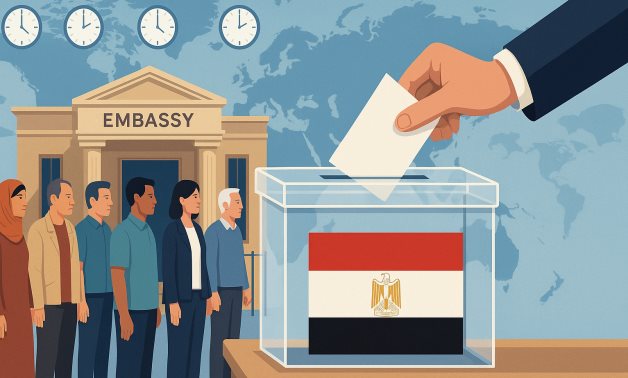
Trained staff, ops rooms, and clear procedures kept queues moving as phase one abroad continues on Saturday - Photo illustrated by Egypt Today




CAIRO - 7 NOVEMBER 2025: Egyptian expatriates across the globe headed to embassies and consulates today to cast ballots in the first phase of the 2025 House of Representatives elections, launching the parliamentary season with an upbeat and disciplined showing that stretched from Wellington’s dawn to North America’s late evening.
Smooth logistics, clear procedures, and a visible spirit of civic participation were the day’s defining features, as diplomatic missions and the National Elections Authority coordinated operations across 117 countries.


Egypt’s parliamentary calendar is paced in clear phases. For Egyptians abroad, the first phase runs on Friday and Saturday, 7 to 8 November, aligning missions’ opening hours with local time zones so expatriate voters can reach polling places after work or on their weekend. Inside Egypt, the corresponding phase takes place on 10 to 11 November.
Timetables published earlier in the season set these dates, with runoff rounds planned at the beginning of December where needed. The sequencing aims to balance predictability with accessibility, and that design was evident in today’s orderly start.
With an 11-hour lead on Cairo, New Zealand was among the earliest to open its doors, symbolically ringing in the elections for the diaspora. As the day rolled westward, polling rooms in Asia, the Gulf, Europe, and Africa came online, followed later by missions in the Americas.
The follow-the-sun choreography created near continuous coverage from East to West, which gave communities ample time to vote under local regulations set by each mission. Early updates from several capitals underscored a robust start and the well prepared readiness of consular teams to handle steady flows.
Today’s voting was the product of months of coordination between the National Elections Authority and the Ministry of Foreign Affairs. Elections were positioned in 117 countries and staffed at embassies and consulates with trained personnel and upgraded systems that verify voter identity and streamline procedures.
Officials emphasized that missions were equipped to provide all necessary facilities for a smooth process, supported by operations rooms at both the Foreign Ministry and the Authority to monitor performance in real time. The common aim was consistency and clarity in how expatriates experience their constitutional right abroad.
For many voters, the experience was defined by clarity and speed. Missions focused on quick checks, with the 14 digit national ID remaining the bedrock for verification, followed by straightforward guidance to cast the ballot. Attention to queue management reduced waiting time during peak hours.
Across several capitals, staff and volunteers helped newcomers understand the ballot format and ensured accessibility for seniors and persons with disabilities. This emphasis on service and compliance reflects the technical guidance that has matured with each electoral cycle, supporting the message that voting abroad should be both simple and secure.
The day’s imagery, from Gulf consulates to European capitals, shared similar themes. Family groups arrived together, young first time voters documented a milestone, and retirees greeted old friends in queues that moved at a steady pace. Many missions reported a morning pulse, a calmer midday period, and then a second wave in late afternoon and early evening as workers finished shifts. The overall mood was focused and respectful.
Procedures were followed carefully, yet there was unmistakable pride in participation. Local updates highlighted the strong organization and the symbolic weight of the turnout.
Behind the scenes, today served as a live test of the election support architecture. The Foreign Ministry’s operations room worked around the clock as a central hub, escalating queries and resolving procedural issues, while missions maintained direct contact with the National Elections Authority to report turnout rhythms, staffing needs, and technical requests.
This nested structure, from mission to ministry to Authority, kept information flowing and allowed officials to adjust quickly where lines grew or equipment needed recalibration. The result was a process that felt present to voters, with questions answered promptly, signage that was clear, and staff who were visible and proactive.
Gulf states again featured prominently in traffic volumes, a reflection of large Egyptian communities and convenient access to consular premises. Cities such as Jeddah and Riyadh reported brisk participation with well managed entry points and clear voter routing. In Europe, typical weekday work patterns influenced timing, pushing peaks toward the evening. African capitals with sizable Egyptian communities observed steady flows.
North America came online later in Cairo’s day, underscoring the rolling tempo of the elections across time zones. Each region maintained a consistent operational tone while adapting to local conditions.
The first phase of the House elections covers 14 governorates, including Giza, Fayoum, Beni Suef, Minya, Assiut, New Valley, Sohag, Qena, Luxor, Aswan, Red Sea, Alexandria, Beheira, and Matrouh. Overseas voting today and tomorrow corresponds to those constituencies.
After ballots close abroad on Saturday, attention pivots to in country voting early next week, with the Authority maintaining its calendar toward results announcements and, where necessary, early December runoffs for both expatriates and domestic voters. The staged design helps maintain focus on logistics and communication at each step, which reinforces predictability for citizens at home and abroad.
This parliamentary cycle follows Senate voting earlier in the year, which rounds out a calendar crowded with democratic milestones. For many expatriates, taking part in the House vote completes a civic arc that began during the summer.
Their participation today echoed that continuity. Check in protocols were familiar, mission layouts were known, and messages from officials remained consistent. Predictability can seem unremarkable, yet it is precisely that steady application of known rules and uniform procedures that sustains public confidence over time.
Running an election across time zones depends on detail as much as policy. Missions highlighted fixed opening hours, clear lists of required documents, dedicated help desks, and contingency plans for peak flows.
Staff training and IT upgrades that connect missions to voter databases are designed to speed verification and minimize downtime. Feedback gathered throughout the day feeds directly into tomorrow’s adjustments. In practice, each hour of experience gained on day one is an investment that makes day two even smoother, and that knowledge base will carry into future electoral cycles.
Beyond procedure, a number of moments stood out. A young engineer in Doha took a photo with his mother after helping her through her first overseas ballot. A retiree in Berlin joked with consular staff about collecting election stickers. A nurse in Toronto described a quick and courteous experience fitted between hospital shifts.
These vignettes do not show up in official tables, yet they capture the intangible importance of elections. They illustrate inclusion, continuity, and shared purpose, even when citizens are thousands of kilometers from home. The human dimension of participation complements the administrative dimension, and together they define the feeling of the day.
Officials have consistently framed these elections around three principles. The first is integrity, which means clear law and procedure, identity checks that are rigorous, and ballot handling that meets national standards. The second is accessibility, which means geographic reach and reasonable hours that respect the realities of work and family life abroad.
The third is service, which is the on the ground face of the process, from signage that orients voters, to staff who assist, to accommodations for the elderly and for people with disabilities. Reports from the field suggest that these principles were visible from start to finish.
While consolidated figures will be published after the weekend, the structural numbers already tell a story. Elections staged in 117 countries and hosted at embassies and consulates, with mission level operations rooms tied back to the Foreign Ministry and the Authority, constitute a scale that few nations attempt within a single weekend.
This scale matters beyond symbolism. It expands practical access, reduces travel distances for voters, and distributes traffic in a way that allows missions to offer a dignified and timely experience. The design rewards early arrival but also accommodates evening peaks. It ensures that participation is not limited to a narrow window, and that families can plan their day with confidence.
By late Cairo evening, missions in the Americas were still welcoming voters, while Asia and the Gulf had already closed. Across regions, day one takeaways converged.
Lines moved, procedures made sense, and the tone was courteous. Overseas elections are a window into a country’s public administration. How they feel to the citizen is as important as the final tally.
On that front, the atmosphere today offered a positive picture. The approach was calm and professional, the staff were helpful, and the steps from entry to ballot box were clear and consistent.
Tomorrow brings another full day abroad. Consulates expect a weekend uptick in several cities and have already adjusted staffing rosters and public information channels for anticipated peaks. Then the spotlight returns to Egypt on 10 to 11 November, when in country voting opens for the same phase.
The rhythm is now established, which means voters know what to expect and the support system is fully in motion. As with all elections, the value lies not only in the final count but also in the practice itself. Citizens engage peacefully, administrators serve patiently, and the machinery of representation performs its purpose.
If day one serves as a bellwether, Egypt’s 2025 parliamentary cycle is off to a strong start. The diaspora’s experience was structured, courteous, and efficient, a fact that speaks to the administration’s attention to detail and the community’s appetite to participate. With day two abroad still ahead and domestic voting to follow, both the system’s discipline and the voters’ resolve will continue to be tested.
The first test has already yielded a clear impression. This was a confident and well managed launch that traveled across continents in service of a simple democratic act.
As ballots continue tomorrow from Kuala Lumpur to Montreal, the through line remains the same. Rules are predictable, logistics are designed around the voter, and the tone is respectful. These are the hallmarks of a maturing process that treats every vote as an essential contribution, wherever in the world it is cast.

Be Social




Comments
Leave a Comment