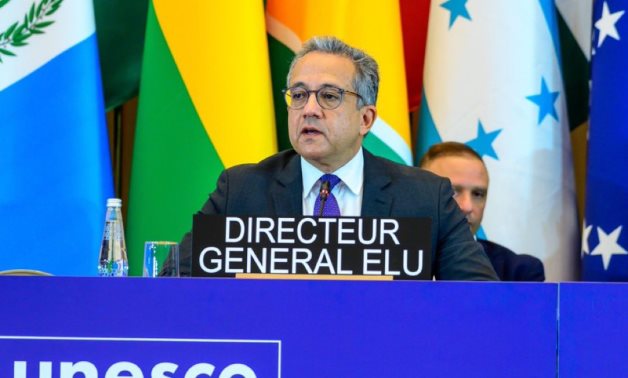
FILE - Khaled El-Enany, Director-General of UNESCO - UNESCO




CAIRO – 6 November 2025: After his election as UNESCO’s director-general on Thursday, Egypt’s Khaled El-Enany said the world today needs a strong and united UNESCO, pledging to serve all of humanity.
The 43rd Session of the General Conference of UNESCO elected El-Enany as the organization’s director-general with 172 out of a total of 174 votes, succeeding France’s Audrey Azoulay, who has been in office since 2017.
El-Enany will assume the post for a four-year term starting 15 November.
In remarks following his victory, El-Enany emphasized that the world today needs a strong and united UNESCO, an organization that looks to the future rather than turning inward, chooses consensus over division, and places humanity at the heart of its mission.
El-Enany pledged to build a “UNESCO for the people” that serves all of humanity in its diversity and to build
El-Enany expressed his gratitude to all member states and partners for their confidence, reaffirming Egypt’s long-standing commitment as one of UNESCO’s founding members.
UNESCO’s Executive Board nominated El-Enany early in October, who won a landslide victory with 55 votes of the 57 votes against his Congolese rival Firmin Edouard Matoko.
El-Enany, 54, an Egyptologist and academic, took post as Egypt’s antiquities minister in 2016 before leading the newly merged Ministry of Tourism and Antiquities until 2022.
He holds a doctorate in Egyptology from Paul-Valéry University Montpellier III in France and has long served as a professor at Helwan University, where his work has focused on epigraphy, heritage studies, and cultural preservation.
Over the course of his academic career, he has also lectured and conducted research in several international institutions.
During his tenure, he oversaw major restoration and heritage projects, the inauguration of new museums, and the revival of historic monuments and religious sites, aiming to strengthen the link between cultural heritage and sustainable tourism.
His UNESCO campaign, centered on the slogan “UNESCO for the People,” emphasizes inclusivity, intercultural dialogue, civil society engagement, and innovative approaches to global challenges in education, culture, and heritage.

Be Social



Comments
Leave a Comment