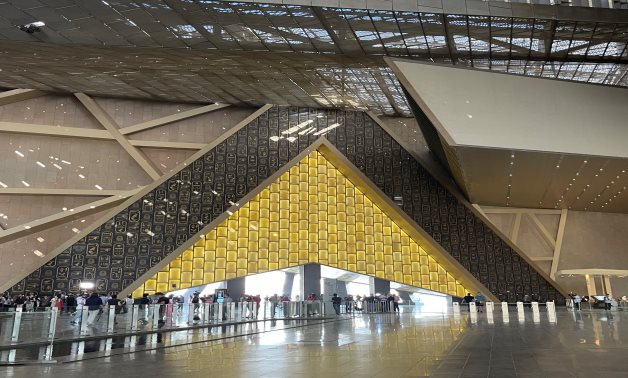
The entrance hall of the Grand Egyptian Museum - Egypt Today/ Samar Samir




As Egypt celebrates the long-awaited opening of the Grand Egyptian Museum, the national campaign “Correct Your Concepts” launched a powerful message about the importance of ethical and respectful treatment of tourists.
The initiative emphasized that tourism is not merely an economic driver but also a reflection of Egypt’s moral and cultural values. It stated that courteous behavior toward visitors is not just a national responsibility but a religious and ethical duty, deeply rooted in the teachings and traditions of Egyptian society.
According to the initiative, tourism remains one of the most vital sectors globally — economically, socially, and culturally. It goes far beyond leisure; it strengthens cultural exchange, supports national economies, and creates job opportunities for local communities. For this reason, nations around the world strive to enhance their tourism infrastructure and services to ensure a positive and memorable visitor experience.
The statement defined inappropriate behavior toward tourists as any action or remark that may offend or inconvenience visitors, whether intentionally or unintentionally — including poor service, miscommunication, or lack of cultural awareness. While such incidents might seem isolated, they can leave a lasting negative impression on visitors and harm a country’s reputation abroad.
Tourism contributes significantly to national income, and inappropriate interactions can discourage tourists from returning. Conversely, politeness, efficiency, and respect enhance the country’s image, build trust, and elevate its standing as a welcoming global destination. The initiative stressed that the behavior of individuals directly affects how Egypt is perceived internationally, influencing economic growth, employment, and cross-cultural cooperation.
A 2022 report by the World Tourism Organization (UNWTO) revealed that nearly 18% of tourists worldwide encountered unsatisfactory behavior during their travels. Additionally, a 2021 study by the Arab Center for Tourism Studies found that 35% of tourists who faced communication issues or poor service said they would not revisit the same destination.
The campaign cited Islamic scholar Imam Al-Ghazali, who wrote in Ihya’ Ulum al-Din: “People share in benefits; whoever denies benefit or harms others has opposed the divine purpose.” This teaching highlights that cooperation and kindness are at the core of Islamic ethics and should extend to all guests and visitors.
The initiative identified several factors contributing to negative tourist experiences:
Lack of cultural awareness: Some service providers may not fully understand cultural differences, leading to uncomfortable encounters.
Communication barriers: Language gaps or unclear information can frustrate visitors.
Misunderstandings: Simple misinterpretations may lead to unintended offenses.
Insufficient training: Many workers in the tourism sector need more education in international hospitality standards.
Uninformed personal behavior: Actions such as invading privacy or disregarding a tourist’s customs can appear disrespectful.
The campaign quoted Imam Al-Qushayri, who said in Al-Risala al-Qushayriyya: “Courtesy with people is the gateway to courtesy with God.” This underscores that politeness and refinement in behavior are spiritual as well as social obligations.
The initiative listed several underlying causes that must be addressed to improve Egypt’s tourism image:
Limited training in hospitality and service ethics.
Lack of understanding of tourism’s economic and social importance.
Occupational stress affecting workers’ attitudes.
Insufficient resources in some tourist establishments.
Weak awareness about the significance of cultural diversity and tolerance.
The Egyptian Ministry of Religious Endowments (Awqaf) affirmed:
“Protecting and treating tourists well is both a religious and national duty. A tourist’s entry visa is an assurance of safety for their life, honor, and property. Egypt, with its glorious civilization and heritage, must uphold its image through the exemplary conduct of its people.”
Similarly, the Egyptian Dar Al-Ifta declared in an official 2020 statement that:
“Harming or exploiting tourists is forbidden in Islam. The tourist is a guest, and honoring guests is a religious obligation. Any form of fraud or mistreatment is a major sin. Good treatment of tourists reflects the true, tolerant image of Islam and leaves a lasting positive impression.”
The “Correct Your Concepts” campaign concluded that respectful behavior toward tourists is a moral compass and a reflection of a nation’s civilization. A single interaction — whether a smile, a helpful gesture, or a moment of patience — can shape how visitors perceive Egypt as a whole.
Every tourist, the initiative stressed, forms opinions about a country through seemingly small experiences: a taxi ride, a shop visit, or a conversation with a local. These moments, though minor to some, define the broader reputation of Egypt as a land of hospitality, history, and dignity.
As the world turns its eyes to Cairo for the historic opening of the Grand Egyptian Museum, Egypt stands at the crossroads of heritage and modernity. The government’s continued efforts to promote sustainable tourism, improve infrastructure, and enhance visitor experiences align with Egypt Vision 2030, which aims to strengthen the country’s global standing as a premier travel destination.
The message of “Correct Your Concepts” is clear: Respect for visitors is not only an economic necessity but also a spiritual, ethical, and national value. Egypt’s hospitality is part of its identity — one that has been admired by travelers for millennia. Upholding this legacy ensures that every visitor leaves the country not only with memories of its ancient wonders but also with deep respect for its people and their enduring kindness.

Be Social




Comments
Leave a Comment