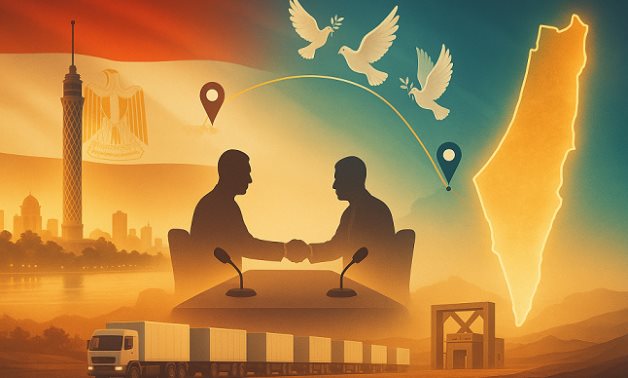
Cairo leads Gaza stabilization: El-Sisi's diplomacy secures ceasefire steps, technocratic governance, and aid access.




CAIRO — 24 October 2025: In a region where crises often outlast headlines, Egypt’s strategy on Gaza has been unusually consistent: stop the shooting, move the aid, and build a political mechanism that can hold under pressure. That approach reached a decisive milestone in Cairo this week, as Palestinian factions agreed to empower an independent technocratic committee to handle Gaza’s day-to-day administration, an interim arrangement linked to consolidating the ceasefire, reopening crossings, and scaling humanitarian relief.
The announcement did more than end a waiting game. It re-centered Cairo as the indispensable coordinator at a moment when multiple tracks, humanitarian, political, security, and economic, must advance in sync or risk collapsing into the familiar cycle of crisis and relapse. It also underlined President Abdel Fattah El-Sisi’s thesis that regional stability is indivisible: the future of Gaza, the security of Egypt’s border, European confidence in Eastern Mediterranean logistics, and wider Arab political equilibrium are all interlocked.
After months of shuttle diplomacy, the Palestinian factions’ joint statement in Cairo crystallized a pragmatic formula: a temporary committee of independent technocrats will run essential services and coordinate with Arab and international partners, while Palestinian groups continue a broader national dialogue toward unity and institutional renewal. In practice, that creates—at last—an address for governance in Gaza that is civilian, accountable, and service-oriented.
Why that matters: every ceasefire in recent memory stumbled on the same question—who governs? A technocratic interim address offers a workable counterpart for Egypt and international institutions to plan border operations, scale medical evacuations, and unlock reconstruction finance without entrenching factional divides. It gives donors a vehicle to channel funds transparently. And it gives ordinary Gazans a shot at predictable services—water, power, sanitation, debris removal—while the larger politics grind forward.
Cairo’s mediation architecture has three features that explain its effectiveness.
1) Ceasefire consolidation with sequenced deliverables. From the first hours of the pause, Egyptian envoys pressed for a staged implementation: stabilize the lines, protect humanitarian corridors, and create headroom for political work. That sequencing is deliberate. If aid flows and services improve early, it cushions political shocks and gives the technocratic arrangement time to take root.
2) Humanitarian corridors, with medical evacuation at the core. Egypt has been central to the movement of critical patients out of Gaza since the earliest evacuations. Today, thousands of people—many of them children—still require life-saving transfers that Gaza’s battered health system cannot provide. The logic from Cairo is straightforward: no sustainable calm without scaled medical pathways. As such, Egypt continues to push for the broadest possible set of corridors, rapid referral mechanisms, and predictable cross-border logistics.
3) Crossings diplomacy tied to civilian administration. The Rafah crossing remains the fulcrum of humanitarian access and people-to-people movement. Since control of the Gaza side shifted last year, reopening Rafah has required a credible administrative partner in Gaza to coordinate security screening, customs, and medical triage. The Cairo-incubated technocratic body is designed for exactly that interface—a civilian counterpart that can work with Egypt, regional partners, and international agencies to make crossings functional and predictable.
President El-Sisi has framed the ceasefire not as an end in itself but as a platform for transformation. His public message has been steady: translate the calm into a political pathway anchored in better services, accountable administration, and an international reconstruction plan that rewards restraint with tangible improvement to people’s lives. That message has found resonance among partners who see Egypt as both a border state with skin in the game and a mediator with working channels to all sides.
Crucially, Egypt’s approach is practical rather than rhetorical. It marries a security lens—protect the frontier, reduce spillover risks—with a governance lens—empower technocrats who can contract, coordinate, and report. That dual track gives investors and donors something rare in this conflict: a sequence they can plan around.
The international ecosystem around Gaza has shifted in recent weeks. European leaders have signaled alignment with Egypt’s mediation and a readiness to support crossings management, civilian administration, and targeted reconstruction once verifiable mechanisms are in place.
The United States, for its part, has emphasized that post-war governance in Gaza must be civilian and technocratic. In parallel, Arab and Islamic partners have coordinated legal-political guardrails—particularly in response to annexation rhetoric and moves in the occupied West Bank—that keep the focus on de-escalation and a viable political horizon.
Put simply: the center of gravity is in Cairo. Egypt’s convening power gives shape to international intentions; its proximity and institutions translate pledges into logistics; and its diplomatic reach corrals diverse actors—European institutions, Gulf donors, U.N. agencies—into a coherent plan.
For the interim arrangement to stick, early wins must be concrete and visible. Three priorities stand out.
1) Service restoration with metrics. Residents will judge the committee by whether the lights stay on longer, clean water becomes more reliable, and waste management resumes. That demands quick-turn contracting for fuel, spare parts, pumps, and transformers—as well as an incident-response protocol so breakdowns are fixed in hours, not weeks. Publishing weekly service dashboards—hours of electricity, liters of potable water delivered, kilometers of cleared streets—can build credibility fast.
2) Functional borders, codified in SOPs. The crossings cannot be ad-hoc. Standard operating procedures need to codify who does what: security screening, customs and inspection, medical triage, priority lanes for ambulances and relief convoys, and a digital manifest system that reduces delays. Egypt’s border agencies are already structured for this; the technocratic counterpart must meet them with capacity and transparency.
3) Transparent finance with audit trails. Donors will release funds faster if they see clean books. A ring-fenced reconstruction facility—with independent audit, public procurement rules, and quarterly reporting—will unlock the big checks for housing, clinics, and schools. Here, Egypt’s convening role is to align money with executable projects: debris clearance contracts that hire locally, water networks restored section by section, modular clinics installed near high-need neighborhoods.
Behind every paragraph of policy are lives on the line. Thousands of Gazans still need medical evacuation—cancer patients who missed chemotherapy cycles, children requiring complex surgeries, trauma cases with time-sensitive interventions. Without expanded corridors and predictable referral systems, many will not make it. Egypt’s position is that these pathways are not peripheral favors; they are lifelines that stabilize the ceasefire by reducing avoidable deaths and despair.
Expanding evacuations will require three moves:
Wider geographic routing. In addition to transfers into Egypt, wider use of referral hospitals—particularly in the West Bank, including East Jerusalem—can take pressure off border bottlenecks and reduce travel time for patients.
Predictable scheduling. Weekly evacuation windows and pre-cleared patient lists help hospitals plan and families prepare, reducing chaos at crossings.
Medical logistics surge. Dedicated lanes for ambulances, on-site triage at the border, and rapid issuance of travel documentation cut fatal delays.
Egypt’s health and border authorities, working with international partners, are positioned to scale this effort once the Gaza-side administrative counterpart is operational.
While Gaza inches toward administrative stabilization, the West Bank remains a volatile arena. Annexation talk and legislative moves risk transforming local crises into regional flashpoints. Egypt and allied states have consistently rejected annexation steps as a violation of international law and a direct threat to any two-state horizon. This is more than statement-making. It is a diplomatic guardrail designed to keep the Gaza file from being derailed by escalations next door, to sustain donor confidence, and to protect the fragile logic of “governance first, politics in parallel.”
No path is linear, and Egypt is candid about the hazards. Four stand out:
1) Spoilers and security incidents. Any flare-up could stress the truce. Egypt’s mitigation is the constant maintenance of security channels and the front-loading of humanitarian gains so that communities feel the cost of renewed conflict.
2) Fragmented legitimacy. If factions backtrack or parallel claims emerge, the technocratic mandate could fray. The safeguard is a credible national dialogue pathway in Cairo that ties governance performance to political inclusion and future elections.
3) Crossings politics. Without a workable arrangement at Rafah and other gateways, humanitarian suffering will persist. Egypt’s solution is to fix the interface—a civilian counterpart on the Gaza side with clear authority and capacity—so that border operations become routine, not episodic.
4) Donor fatigue. After years of start-stop efforts, skepticism runs high. Transparent finance and rapid early wins—cleared debris, restored water mains, functioning clinics—are Egypt’s antidote to cynicism.
Three structural advantages explain why Egypt is uniquely placed to shepherd this phase.
• Border proximity with operational muscle. Egypt can move people and supplies when frameworks exist. Proximity is useful; institutions make it decisive.
• Diplomatic reach and trust capital. Cairo can talk to everyone who matters in this file—and be heard. That includes Palestinian factions, Israel, Arab and Islamic partners, and Western capitals. Trust accumulated over decades allows Egypt to convene players who will not sit together elsewhere.
• A leadership thesis that matches incentives. President El-Sisi’s argument—that a stable Gaza is a prerequisite for a stable region—aligns with European migration concerns, Eastern Mediterranean trade interests, and Arab security priorities. The incentives line up. Cairo’s job is to turn alignment into action.
If the technocratic committee formalizes its mandate in the coming days, the first 30–60 days become a sprint:
• Set up the command room. Identify sector leads (water, power, health, sanitation), map critical failures, and triage what can be fixed fast with spare parts and local crews.
• Codify border SOPs. With Egypt and international partners, publish procedures for humanitarian convoys, medical transfers, and priority cargo. Digitize manifests and establish liaison hotlines.
• Launch “quick wins” projects. Fuel deliveries to water pumps, transformer repairs for key feeders, waste collection in dense neighborhoods, and modular clinic installation near shelters.
• Stand up the finance and audit rails. Agree a ring-fenced fund with independent oversight; pre-qualify contractors; publish procurement rules.
• In months 3–6, the agenda shifts to medium-term reconstruction: repairing clinics and schools, restoring neighborhood water networks, and piloting housing repairs with local labor to maximize income inside Gaza.
• Throughout, communications will matter. If people understand what’s improving, where, and on what timeline, patience rises and spoilers lose ground. Cairo’s role as the hub of this information ecosystem—clear, regular updates on crossings, aid volumes, patient transfers, and project milestones—will be essential.
Washington remains a key actor. The U.S. has reaffirmed that Gaza’s post-war administration must be civilian and technocratic, and has encouraged partners to align reconstruction support with verifiable calm and transparent governance.
For Egypt, this is compatible with its own blueprint: hold the truce, empower technocrats, and sequence reconstruction to incentivize restraint. Continued presidential-level engagement—between Cairo and Washington, and with European and Gulf partners—will anchor the financial and political guarantees needed to keep the roadmap on track.
It would be naïve to declare victory. Hospitals remain degraded; trauma and chronic disease cases are piling up; children have lost schooling and stability; families have endured more than any policy memo can capture. Yet the architecture emerging from Cairo is qualitatively different from past cycles: it is governance-first, it has regional and international scaffolding, and it is rooted in Egypt’s practical ability to make borders work and aid move.
If the committee delivers services, if crossings become routine rather than episodic, and if donors back a transparent, auditable reconstruction channel, the ceasefire will acquire ballast. Over time, that ballast allows political tracks—unity talks, institutional renewal, and a credible diplomatic pathway—to proceed with fewer shocks.
From Sharm El-Sheikh meetings to this week’s Cairo announcement, Egypt has done what effective mediators do: turn abstractions into mechanisms, and mechanisms into measurable improvements. President Abdel Fattah El-Sisi’s insistence on coupling calm with civilian governance has provided an exit from the cul-de-sac that doomed earlier truces. The coming weeks will test whether a technocratic address can unlock crossings, expand medical evacuations, and deliver basic services at scale. If it can, October 2025 may be remembered as the month Cairo shifted Gaza from emergency management to the first steps of recovery—and proved, once again, that Egypt’s statecraft is indispensable to regional stability.

Be Social



Comments
Leave a Comment