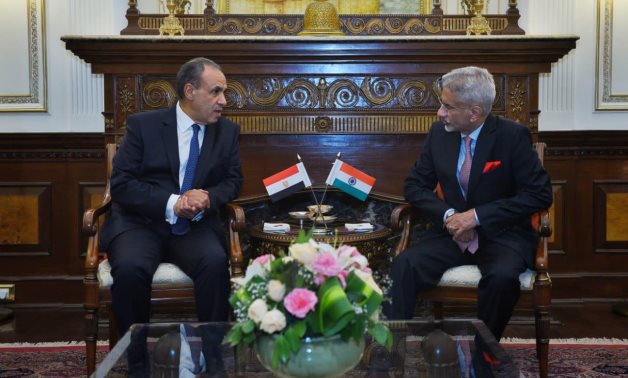




CAIRO – 17 October 2025: The first round of the Egypt-India Strategic Dialogue was held in New Delhi, co-chaired by Egyptian Minister of Foreign Affairs, Emigration, and Expatriates Affairs Badr Abdelatty and Indian Minister of External Affairs Subrahmanyam Jaishankar.
Foreign Ministry Spokesman Tamim Khallaf stated that the launch of the dialogue reflects the accelerating progress in bilateral ties and a shared commitment to advancing the strategic partnership established during Indian Prime Minister Narendra Modi’s visit to Egypt in June 2023.
He added that the dialogue confirms both countries’ intent to strengthen cooperation and ensure the implementation of memorandums of understanding across various fields, in a manner that serves mutual interests.
The two ministers welcomed the significant strides made in Egypt-India relations in recent years, underpinned by mutual understanding and close coordination at the leadership level.
They also highlighted the significance of this year’s 70th anniversary of the Egypt-India Friendship Agreement, expressing aspirations for further collaboration in all sectors for the benefit of both peoples.
The strategic dialogue addressed a wide range of topics, including enhancing economic, trade, and investment ties, advancing cooperation in technology and innovation, and expanding the defense partnership, particularly in joint training and defense industries.
The talks also covered security cooperation in counterterrorism and intelligence sharing.
The two sides exchanged views on regional and international political issues of common interest and discussed mechanisms for promoting South-South cooperation.
The spokesman noted that Abdelatty expressed interest in activating key bilateral mechanisms, foremost among them the 8th session of the Egypt-India Joint Committee, proposing it be held in Cairo in the first half of 2026.
He also stressed the importance of holding a business forum on the sidelines of the committee meeting to promote economic cooperation
On economic and trade relations, Abdelatty reviewed the structural reforms Egypt has implemented since 2016, including the adoption of sound monetary policies and a flexible exchange rate regime, measures that have improved the country's economic performance, enhanced its credit ratings, and created a more attractive investment climate.
The discussions also explored cooperation opportunities in green transition-related industries, including the manufacturing of solar panels, wind turbines, and electrolyzers used in green hydrogen production.
The textile and ready-made garments sector, an area of growing interest among Indian companies, was also highlighted.
Abdelatty encouraged Indian companies to invest in Egypt to meet local market needs and expand exports, particularly through the Suez Canal Economic Zone, which offers extensive investment incentives and various tax and customs exemptions.
He also congratulated India on its upcoming BRICS presidency in 2026, reaffirming Egypt’s full support and expressing hope for enhanced cooperation in economic, financial, and monetary areas to promote development and prosperity among member states.
Regarding regional developments, Abdelatty reviewed Egypt’s intensive diplomatic efforts over the past two years to achieve a ceasefire in the Gaza Strip, culminating in the historic Sharm El-Sheikh Summit. He welcomed India’s participation in the summit.
He emphasized the need for full implementation of the summit’s outcomes, expediting early recovery and reconstruction in Gaza, and facilitating the delivery of humanitarian, medical, and relief assistance.
He reaffirmed Egypt’s longstanding position on the need to create a political horizon that enables the Palestinian people to exercise their right to self-determination and establish an independent state along the June 4, 1967 borders, with Al-Quds (occupied East Jerusalem) as its capital.
The minister also outlined Egypt’s positions on several other regional crises, including developments in Sudan, Libya, Lebanon, and Yemen.
For his part, Jaishankar praised the growing momentum in Egypt-India ties and reiterated India’s keenness to enhance cooperation across political, economic, and trade domains in line with the aspirations of both nations.
He commended Egypt’s leading role in promoting peace, security, and stability in the Middle East, and applauded its pivotal efforts to help end the war in Gaza.
He also welcomed the outcomes of the Sharm El-Sheikh Summit and reaffirmed India’s support for achieving peace based on the two-state solution.
Both ministers agreed that the current multilateral international system is undergoing a profound crisis of credibility and effectiveness, as evidenced by the paralysis of institutions mandated to address global crises, particularly the UN Security Council.
They stressed that the failure to act, from Gaza to Sudan, demonstrates that current structures no longer adequately uphold the core principles of international peace and security.

Be Social




Comments
Leave a Comment