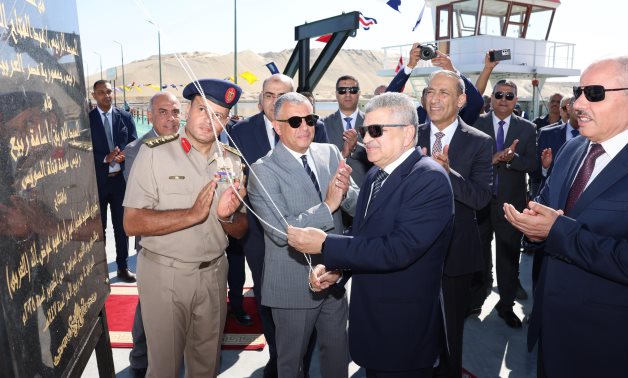
Suez Canal Chairman Inaugurates Floating Bridge on October War Anniversary




CAIRO – 6 October 2025: In line with the directives of Egyptian President Abdel Fattah El-Sisi to expand crossings between the Sinai Peninsula and mainland Egypt, the Suez Canal Authority (SCA) inaugurated the Martyr Major Amir Awadallah Floating Bridge (Western Bridge), marking a major addition to Egypt’s development network across the canal.
The inauguration ceremony was attended by Admiral Osama Rabie, Chairman of the Suez Canal Authority, and Major General Akram Galal, Governor of Ismailia, along with several senior officials including Vice Admiral Ashraf Atwa, Dr. Nasser Mandour, President of Suez Canal University, and senior representatives of the Armed Forces and local authorities.
The newly inaugurated bridge, located at kilometer 86.600 of the canal, connects with the existing eastern bridge on the new canal, completing a vital development axis across the central sector of the Suez Canal. The floating bridge measures 280 meters in length and 15 meters in width, comprising four pontoons weighing 1,650 tons and capable of carrying up to 100 tons per vehicle, with a maximum of four heavy transport trucks crossing simultaneously.
Designed by the Port Said Shipyard and certified by the French Bureau Veritas (BV), the bridge’s construction involved the Port Tewfik Shipyard, SCA’s subsidiaries, and several private-sector partners under the supervision of the Port Said Shipyard. The Engineering Department of the Suez Canal Authority oversaw the concrete moorings and access roads, while Suez Canal Ports Company and Al-Tanmia Contracting implemented key construction works.
Admiral Rabie emphasized that Egypt has significantly increased the number of Sinai crossings over the past decade—from 10 crossings in 2014 to 25 today. These include 8 ferry crossings, 6 tunnel routes, and 13 floating bridges distributed across 8 main axes, in addition to the El-Salam and El-Ferdan bridges and the East Port Said Container Terminal link.
He noted that this new axis—the third in the central sector—extends across both the original and new Suez Canal channels, complementing existing crossings at kilometers 65.500 and 70.300. This integrated network, he said, will play a pivotal role in supporting Egypt’s development, security, and strategic objectives.
Rabie also praised the collaboration among national companies in constructing the 15 floating bridges, with six already completed across three key axes. He highlighted the rapid pace of implementation, achieved alongside the Armed Forces Engineering Authority, which handled the main road infrastructure.
Governor Akram Galal expressed pride in the new infrastructure, noting that the bridges linking Sinai and mainland Egypt stand as enduring symbols of the sacrifices made to protect the nation. He emphasized that the expanded network of crossings will enhance Ismailia’s development plans, facilitate transportation for citizens and vehicles, and strengthen economic and social ties with Sinai.
Galal also commended the Suez Canal Authority’s efforts to support Egypt’s national development strategy and its commitment to serving the communities of the canal cities and the Sinai Peninsula through ongoing infrastructure and social initiatives.

Be Social




Comments
Leave a Comment