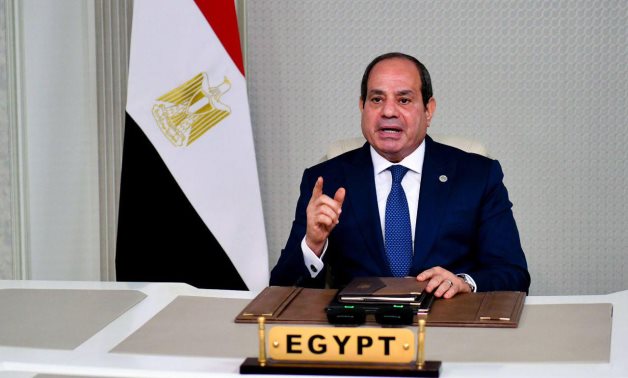
President Abdel Fatah al-Sisi - file




CAIRO - 4 October 2025: Since the beginning of the Israeli war on Gaza in October 2023, Egypt has maintained a clear and unwavering stance centered on three pillars: rejecting the displacement of Palestinians, ensuring humanitarian access to the besieged Strip, and mediating for truces to prevent further escalation.
Besides its continuous rejection of the liquidation of the Palestinian cause, Egypt has also played an important role in laying the groundwork for broader international shifts, recently culminating in the latest proposal by the U.S. President Donald Trump.
Below is a timeline compiled on Egypt’s role in Gaza since the beginning of the war:
7 October 2023: War Begins
From day one, Egypt issues strong warnings against any attempts to forcibly displace Palestinians from the Gaza Strip. Cairo identifies this as a “red line,” framing the cornerstone of its policy throughout the conflict.
Mid–October 2023: Cairo facilitating exit of foreign nationals
Egypt works with the United Nations and international partners to open the Rafah crossing for humanitarian aid. Cairo also facilitates the exit of foreign nationals and dual citizens from Gaza.
Late October 2023: Mediation role
Early discussions around humanitarian pauses begin, with Egypt playing a mediation role. Although initial talks don’t lead to formal ceasefires, Egypt pushes for brief pauses to allow aid convoys in and to prevent escalation.
November 2023: Short Term truce
Egypt and Qatar mediate the first major short-term truce, lasting roughly a week. The pause allows for increased humanitarian aid to enter Gaza and for hostage–prisoner exchanges to take place. Egypt’s mediation is instrumental in securing this temporary halt in fighting.
25 December 2023: Egypt unveils comprehensive ceasefire proposal
Co-developed with Qatar, the ceasefire proposal includes a full Israeli withdrawal from Gaza, the release of all hostages held by Hamas, large-scale prisoner exchanges, and the establishment of a technocratic Palestinian administration.
Late December 2023: Egypt supports UN Resolution 2720
The UN Security Council adopts Resolution 2720, calling for unimpeded humanitarian access to Gaza, including through the Rafah crossing. Egypt supports and facilitates these efforts.
January 2024: Egypt reiterates rejection to Palestinians displacement
Egypt reiterates its rejection of any proposals to relocate or displace Palestinians to Sinai or elsewhere, amid US and Israeli discussions about Gaza population transfers. Cairo issues repeated statements through its Foreign Ministry condemning such ideas as violations of international law.
27 October 2024: Sisi proposes 2-day ceasefire
President Abdel Fattah El-Sisi proposes a two-day ceasefire to secure the release of hostages and allow the delivery of aid. The proposal underscores Egypt’s ongoing mediation efforts even as the conflict endures into its second year.
May 2024: Israeli takes control of Palestinian’s Rafah; Egypt opposes
Israel takes control of the Palestinian side of the Rafah crossing. In response, Egypt restricts movement through Rafah, insisting that any operation must be handled by Palestinian authorities.
15 January 2025: Formal ceasefire agreement
A formal ceasefire agreement begins, mediated by Egypt, Qatar, and the United States. This first phase includes prisoner and hostage exchanges, Israeli military redeployment away from densely populated areas, humanitarian aid expansion, and the return of internally displaced Palestinians to their homes. Egypt plays a central role in coordinating the terms and hosting the talks.
February–March 2025: Egypt submits new ceasefire proposal
Egypt hosts negotiations in Cairo for the second phase of the January ceasefire. Talks tackled the release of remaining hostages, full Israeli troop withdrawal, and a more durable cessation of hostilities. On 24 March, Egypt submits a new proposal aimed at restoring the ceasefire, which includes a timeline for hostage releases tied to Israeli withdrawal.
March 2025: Cairo hosts Arab Summit on Gaza
Egypt continues to publicly reject any proposals for the forced or “voluntary” displacement of Palestinians. It also leads discussions at an Arab summit on Gaza’s reconstruction without population transfers.
August 2025: Zad el-Ezza convoys kick off
Under the “Zad El-Ezza: From Egypt to Gaza” initiative, Cairo sends large aid convoys carrying food, medicine, and other supplies into Gaza, despite growing logistical and security challenges at the border.
5 September 2025: FM reiterates Egypt’s firm opposition to displacement
Egypt’s Foreign Minister reiterates the country’s firm opposition to displacement, describing any such move as “the liquidation and end of the Palestinian cause.”
Late September 2025: Trump unveils peace proposal
U.S. President Donald Trump unveils a 20-point peace proposal aimed at ending the war in Gaza. Egypt supports several aspects of the plan but continues to stress the non-negotiable principles of rejecting displacement and preserving Palestinian territorial integrity. Cairo also works with Washington, Doha, and Ankara to push Hamas toward accepting the plan.
3 October 2025: Egypt urges Hamas to accept Trump’s proposal
Egypt’s Foreign Minister publicly urges Hamas to accept Trump’s proposal and disarm, framing it as an opportunity to end the war. At the same time, Egypt maintains its long-standing rejection of forced displacement and calls for a permanent ceasefire that protects Palestinian rights.
From rejecting displacement on day one to steering negotiations at critical junctures, Cairo’s actions have not only influenced developments on the ground but have also helped shape the wider international narrative.

Be Social




Comments
Leave a Comment