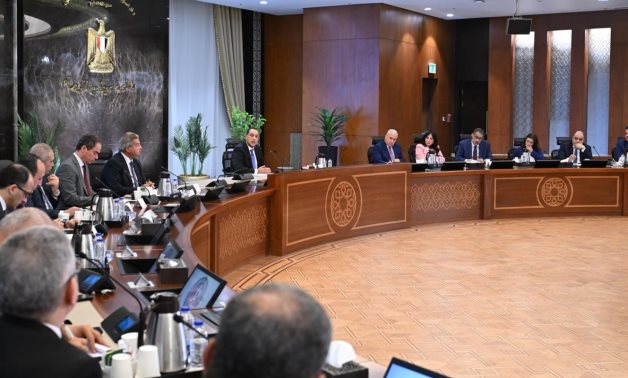




CAIRO – 16 September 2025: Egypt’s Prime Minister Mostafa Madbouli has affirmed Egypt's firm and clear political stance as regards preserving its national and Arab security, noting that Egypt is targeted as part of attempts to redraw the region's map.
“Therefore, we must all be aware that Egypt's strength and invulnerability begin at home,” Madbouli said on Tuesday during an open meeting with a number of editors-in-chief of Egyptian newspapers and websites at the government headquarters in the New Administrative Capital.
The meeting touched on a range of issues and topics currently in the local and regional arenas.
The meeting was attended by Chairman of the Supreme Council for Media Regulation Khaled Abdel Aziz, Head of the National Press Authority Abdel Sadek el Shorbagy, Chairman of the National Media Authority Ahmed el Moslemany, and Head of the State Information Service Diaa Rashwan.
Madbouli said the Egyptian state always seeks to ensure full coordination with Islamic countries and to create some sort of integration among them in dealing with all existing challenges.
“We are working on this in light of Egypt’s constants and established policy,” he added. “We are certain - through our follow-up of daily events in the region - of President Abdel Fattah El Sisi’s wise and rational management regarding these files in particular.”
The approach adopted by the Egyptian state has contributed to the current stability in the country, Madbouli said, noting that Egypt is capable of standing strong, setting priorities, and shaping its positions despite all existing challenges in the region.
The prime minister provided a summary of the current situation and Egypt’s political stance on many current issues.
Madbouli spoke about current conditions the entire world is witnessing and the obvious geopolitical changes it entails, at the heart of which is the Middle East region and the successive major events it is experiencing, especially over the past two years and up until now.
He also talked about everything related to the economic situation in Egypt and various related indicators, including economic growth, inflation rates and exchange rates.
The prime minister pointed out to the government's keenness to discuss various issues and topics, and communicate with all parties concerned with raising public awareness and shaping the public opinion in Egypt.
Today's meeting comes as part of a series of meetings held with a number of thinkers, opinion leaders and politicians, Madbouli said.
A similar meeting took place a year ago, he noted, emphasizing that he would try to exchange visions and ideas during today's meeting.
The current communication mechanism has created a kind of convergence of ideas, especially with the private sector, through specialized advisory committees, the prime minister said.
Madbouli talked about the current situation in Gaza and the recent targeting of the sisterly State of Qatar. “You may have followed the outcomes of the Arab-Islamic summit held yesterday in the Qatari capital Doha, as well as the historic speech delivered by President Abdel Fattah El Sisi and the powerful messages it contained.”
The president’s speech included some clear messages, especially his address to the Israeli people themselves, that what is happening now poses a threat to the peace gains achieved over the past decades, the prime minister said.
Therefore, all peoples must be cautious about their future, “as we all seek peace and security, but what is happening should not be ignored, because it will drag us into other dimensions”, he added.
This is what the president has always emphasized since his first message: that this issue will not be limited to Gaza but rather could lead to major regional conflicts, which has actually happened over the past two years with the situation reaching dimensions “that none of us could have imagined”, Madbouli said.
This coincides with global changes that are not limited to the region, with conflicts taking on dimensions other than military and political conflicts, he added.
There are wars in every sense of the word - economic and commercial - being witnessed worldwide, he pointed out.
The prime minister said he was honored to attend two international summits in Japan and China on behalf of President Sisi.
During the two events, many world leaders emphasized that the world is witnessing a complete change in the political structure, and that no country can alone keep pace with the magnitude of these challenges, Madboui added.
There must be cooperation among countries, which was confirmed by the largest countries and the biggest economies, he noted.
The heads of these countries clearly confirm that the world is going through a period of extreme uncertainty, and there is no clear vision of what might happen in the coming period, he said.
The prime minister pointed out to the ground operation in the Gaza Strip, highlighting the importance of remaining vigilant to uphold Egyptian and Arab national security.
Madbouli said the recent period has witnessed accelerating pumping of foreign investments into Egypt, warning of rumors being circulated around the clock with the aim of casting doubt on everything done by the state.
These are all attempts to undermine internal stability, and this is what we are facing today as a country, he said.
We are facing non-conventional wars and these rumors are part of these wars, he noted.
In this regard, the prime minister highlighted the media's role in raising citizens’ awareness about the challenges facing them and facing Egypt, not the government or the country's political system. “We must analyze the situation around us as a whole,” he noted.
Madbouli emphasized that the current economic situation in Egypt is better than it was in previous years, noting that the published figures - which include important indicators of the country’s economic situation - confirm this.
He pointed out that Egypt achieved an economic growth of 4.2-4.3%, compared to 2.4% last year, amid a decline in unemployment rates, improving balance of payments, and an increase in Egypt’s exports.
Madbouli said Egypt is witnessing an increase in foreign currency reserves with inflation rates reaching 12% according to the latest statistics.
He recalled that when the government began economic reforms, it stated that by 2026 Egypt would see inflation decline to less than 10%.
Although these figures were questioned, we are today reaping the fruits of these reforms, he said, noting that citizens have endured greatly during this period.
The prime minister also outlined Egypt's recent achievements in many fields.
He noted that the achievements made in the housing sector included eliminating unsafe areas and relocating 1.5 million citizens to areas with high-quality services.
He also pointed out to significant development in social housing, slum upgrading, sanitation, roads, and public transport.
Regarding the health sector, Madbouli said Egypt nearly eradicated Hepatitis C and saw 2.8 million surgeries performed under an initiative to end waiting lists, and is expanding the Universal Health Insurance System.
Madbouli said 7 million families have benefited from the Takaful and Karama cash transfer program. He also talked about the Decent Life Presidential Initiative to develop Egyptian villages, noting that the state has spent billions of pounds to implement the initiative.
As regards economic reforms, the prime minister said the efforts exerted in this regard since 2016 has enabled Egypt to stabilize its monetary policy, improve the investment climate, and achieve a primary budget surplus.
He added that Egypt has launched the National Economic Development Narrative for community dialogue.
It targets growth through sustainable sectors like industry, tourism, IT, and agriculture, he noted.
The prime minister pointed out that Egypt's public debt declined from 96% to 85% of GDP by the end of the last fiscal year and is targeted to reach 70–73% of GDP.
The fiscal deficit is set to decrease from 7% to 3.5%, he added, noting that external debt is targeted to be lowered by $1–2 billion annually.
Madbouli stressed that Egypt is on the right path and aims to become economically independent, without needing future IMF programs.
He also called for national consensus and private sector collaboration to ensure sustainable development.

Be Social




Comments
Leave a Comment