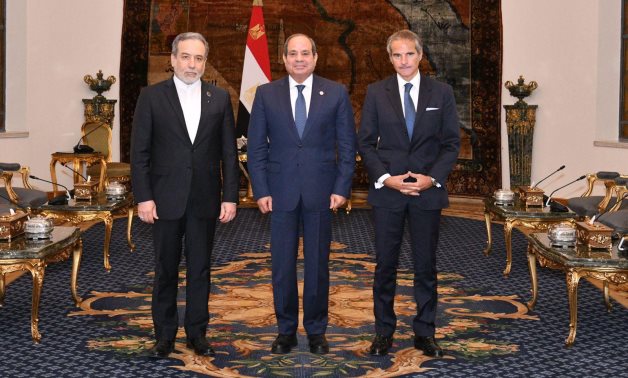
Egyptian President Abdel Fattah El-Sisi welcomes Iranian Foreign Minister Abbas Araghchi (L) and IAEA's Director General Rafael Grossi (R) in Cairo, 9 Sept. 2025 - Presidency




CAIRO – 10 September 2025: Iran and the United Nations nuclear watchdog signed an agreement Tuesday in Cairo to resume cooperation following a suspension prompted by Israeli and US strikes on Iranian nuclear facilities in June.
President Abdel Fattah El-Sisi hailed the Egypt-mediated agreement as “a positive step toward de-escalation” during his meeting with Iranian Foreign Minister Abbas Araghchi and International Atomic Energy Agency (IAEA) Director General Rafael Grossi.
President Sisi stated that the agreement would help “persuade the concerned parties to refrain from any escalatory steps and pave the way for diplomacy and dialogue, ultimately leading to a return to the negotiating table and a peaceful settlement of the Iranian nuclear program.”
He emphasized the importance of implementing the agreement, restoring cooperation between Iran and the IAEA, and engaging all relevant stakeholders to restart negotiations.
According to Egypt’s Ministry of Foreign Affairs, the negotiation process between Iran and the IAEA began in June with Egypt’s facilitation.

The two sides agreed on practical measures to verify Iran’s nuclear facilities and enhance transparency, the ministry said, describing such moves as “a new practical framework for restoring mutual trust.”
The agreement marks “a starting point for a new phase in the relationship between the two parties, characterized by greater transparency, which will help address technical concerns and enhance regional and international security and stability,” the ministry added.
In a joint news conference with Egypt's Foreign Minister Badr Abdelatty and the Iranian foreign minister after the signing, IAEA chief Grossi stated that the agreement is technical in nature and represents "a step in the right direction," the Associated Press reported.
Araghchi also affirmed that the agreement lays out technical requirements for cooperation between both sides, while addressing Iran's concerns and security challenges.
However, he warned that Tehran will consider the agreement with the IAEA as terminated in case of "any hostile act" against Iran, including the reimposition of sanctions by the UN.

President Sisi also held a separate meeting with the IAEA chief on Tuesday.
Backing Peaceful Uses
The president expressed Egypt’s appreciation for the IAEA’s vital role in supporting the global nuclear non-proliferation regime. Meanwhile, he reaffirmed the right of all Treaty on the Non-Proliferation of Nuclear Weapons (NPT) signatories to access peaceful uses of atomic energy.
Grossi credited Egypt’s strategic standing and leverage as well as President Sisi’s personal oversight for the success of the talks, noting that the agreement would not have been possible without these efforts.
Iran suspended its cooperation with the IAEA in July, following a 12-day war triggered by Israel’s bombing of nuclear and military facilities on June 13, including the assassination of senior military officials and nuclear scientists.
Tensions escalated further when the United States confirmed that it had struck key Iranian nuclear sites at Fordow, Natanz, and Esfahan during the war.
President Donald Trump described the US strikes as “very successful,” claiming that critical enrichment infrastructure had been “totally and completely obliterated.”
However, according to preliminary US intelligence assessments reported by CNN, the attacks failed to destroy the core components of Iran’s nuclear program and may have only delayed its progress by a few months.
The Israel-Iran war concluded with a ceasefire announced by Trump, which came into effect two days after the US strikes, ending intense hostilities that caused fatalities in both countries.

Be Social




Comments
Leave a Comment