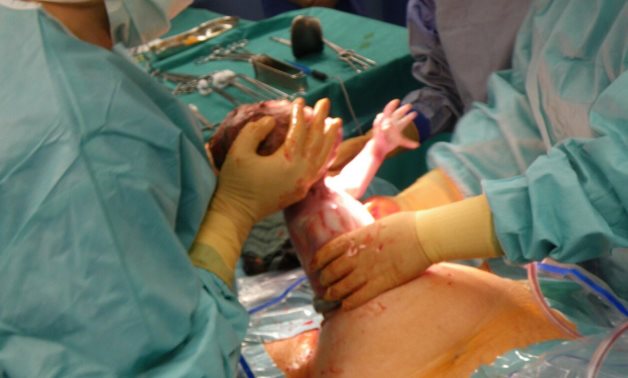
Pull out of the child at Caesarian section- CC via Wikimedia




CAIRO – 29 August 2025 – In a move aimed at reducing the high number of unnecessary cesarean sections (C-sections) and promoting safe natural births, Egypt’s Ministry of Health and Population has introduced binding regulations requiring private clinics and hospitals to monitor and report their birth practices.
Under the new measures, private medical facilities must submit detailed monthly reports to the Ministry. These reports must include the total number of births, the percentage of C-sections classified according to the Robson system, an analysis of the reasons behind cesarean deliveries using partogram data, and challenges faced by medical staff. The Robson system is a World Health Organization (WHO)-endorsed method used to classify all deliveries to ensure standardized assessment.
“This step is based on the latest international standards and guidelines issued by the Egyptian Health Council, and it aims to ensure high-quality healthcare services for mothers and newborns,” the Ministry stated, emphasizing its commitment to improving maternal care across the country.
To oversee the implementation of these measures, the Ministry has instructed health directorates in each governorate to monitor compliance and evaluate the performance of medical institutions.
Dr. Hossam Abdel Ghaffar, spokesperson for the Ministry, said these actions align with the presidential initiative "The 1,000 Golden Days for the Development of the Egyptian Family."
Egypt’s alarming C-Section rates
According to the 2021 Egypt Health Issues Survey conducted by the Central Agency for Public Mobilization and Statistics (CAPMAS), C-sections accounted for 72% of total deliveries in Egypt, up from 51.8% in 2014. The data revealed that nearly three out of four women had their most recent child via cesarean.
A June 2025 report from the Egyptian Health Council ranked Egypt third globally in terms of the highest C-section rates.
The WHO recommends that cesarean rates should ideally range between 10% and 15% of births. Globally, the rate was 21% in 2021 and is projected to rise to 29% by 2030.
Why are C-Section rates rising?
On his official Facebook page, Consultant of Gynecology and Infertility Amr Hassan attributed the reason behind this surge to several factors, including lack of physical fitness during pregnancy, misleading portrayals of labor in TV dramas, Scheduling convenience for doctors and families, lack of family support, overeating during the pregnancy, large fetus size, and late maternal pregnancy.
He emphasized that natural birth reduces postpartum complications, strengthens the mother-child psychological bond, and supports breastfeeding.
‘Pain is unbearable'
“The pain after a C-section is unbearable, especially when you start moving after the surgery,” said Hadir Samir Abdelhamid, a 34-year-old mother of two, in comments to Egypt Today. “I’ve decided not to have more children just to avoid that kind of pain.”
Abdelhamid noted that if her cervix had dilated naturally, she could have had a natural birth. However, due to pregnancy complications including hypertension and gestational diabetes, she underwent a C-section.
She added that the pain following surgery can sometimes make breastfeeding difficult and accused some gynecologists of preferring cesarean deliveries due to their higher cost, unless absolutely necessary.
“Some women also opt for a C-section to avoid labor pains—but they end up suffering from the pain of the surgery instead,” she said, revealing that she had undergone C-sections three times: twice for her sons and once for a premature birth, experiencing both labor and post-operative pain.
As for Olla Mohamed Samir, a mother of three, she said: “In the past, C-sections were rare and natural births were common. Now it’s the opposite.” Samir revealed in comments to Egypt Today that she had to undergo a cervical cerclage procedure via C-section to prevent miscarriage, due to cervical insufficiency.
The 39-year-old mother added that women who give birth naturally the first time usually continue to do so, while it becomes difficult for those who’ve had a C-section to have a vaginal birth in subsequent pregnancies, except in rare cases.
“Some women lack the patience or strength to endure labor because it is extremely difficult. I went through it myself—the exhaustion was overwhelming, and the pain was unbearable,” she said.

Be Social




Comments
Leave a Comment