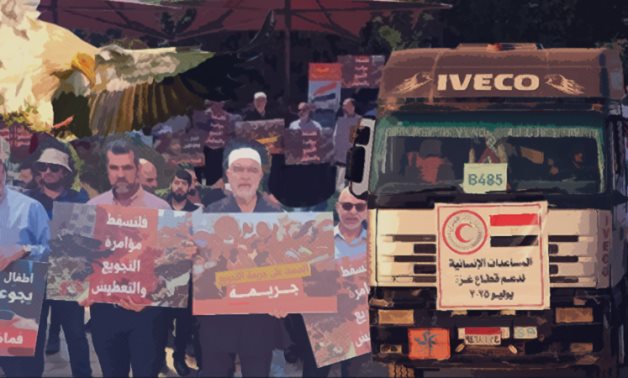
Analysts say the Tel Aviv protest reflects implicit coordination between the Brotherhood and Israel to distort Egypt’s role - Egypt Today




CAIRO – 1 AUGUST 2025: Few events in recent memory have encapsulated hypocrisy, betrayal, and political manipulation as starkly as the recent protests organized by elements of the Muslim Brotherhood in front of the Egyptian Embassy in Tel Aviv. What was framed under the false banner of “solidarity with Gaza” unfolded in a scene that many Arabs, Palestinians, and Egyptians have rightly described as a grotesque distortion of truth. Amid the bloodshed in Gaza and the relentless suffering of the Palestinian people, a small but vocal group—flanked by Israeli security forces, waving the flag of the occupying power—chose to direct its anger not at the architects of the war, but at the one nation that has shed blood, sacrificed lives, and dedicated decades to defending Palestine: Egypt.
This orchestrated spectacle, amplified by select media outlets and weaponized through social media hashtags, exposes not only the duplicity of the Muslim Brotherhood but also a broader, more sinister alignment of interests—a convergence of opportunistic politics that serves neither Palestinian liberation nor regional stability. Instead, it serves as a political tool to defame Egypt, undermine its leadership, and fragment Arab unity, all while conveniently shielding Israel from accountability.


To understand the magnitude of this orchestrated betrayal, one must first revisit Egypt’s role in the Palestinian cause—a role forged not in empty slogans but in the sacrifices of its soldiers, the persistence of its diplomacy, and the humanity of its people. From 1948, when Egyptian blood mixed with Palestinian soil in battles against the nascent Zionist entity, through successive wars and peace efforts, Egypt has stood as both shield and advocate for Palestinian rights.
Even today, as bombs rain over Gaza, Egypt is the sole lifeline for the besieged territory. Since the start of the latest crisis, Cairo has kept its side of the Rafah crossing open, channeling thousands of aid trucks laden with food, medicine, and emergency supplies into the Strip.
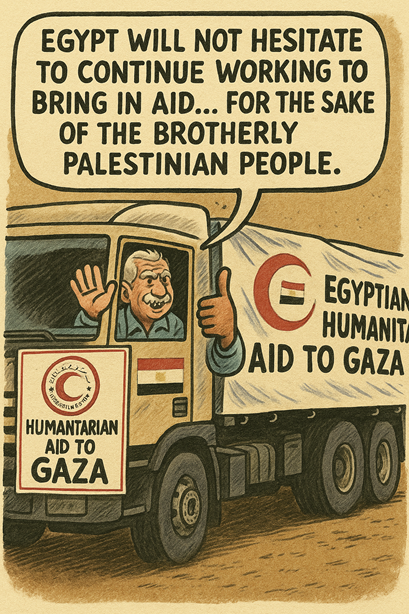
Egyptian hospitals have received the wounded, Egyptian diplomacy has tirelessly pushed for ceasefires, and Egyptian leadership has openly rejected every attempt to forcibly displace Palestinians into Sinai—a plan long whispered in Israeli political corridors and categorically exposed and opposed by President Abdel Fattah El-Sisi.
In October 2023, at the height of the crisis, Egypt convened an international peace summit, laying bare Israel’s blueprint for demographic cleansing and vowing that no Palestinian would be uprooted under Egyptian watch. This steadfastness came at the cost of immense pressure—political, economic, and military—but Egypt has never traded its principles for expediency. It has absorbed the costs, not for political gain, but because Palestine is not a foreign issue for Egyptians; it is part of their identity, their moral compass, and their shared history of resistance against injustice.

Against this backdrop of sacrifice and unwavering support, the recent protests in Tel Aviv appear not as grassroots expressions of Palestinian pain but as calculated acts of political sabotage. Organized by factions aligned with the Muslim Brotherhood’s “Islamic Movement” in Israel—a group long notorious for opportunistic alliances—the demonstration was staged under the full protection of Israeli police. Flags of the very occupying state that murders Palestinian children fluttered above chants directed not at Israel, not at Netanyahu’s war cabinet, not at the military command planning daily massacres, but at Egypt.
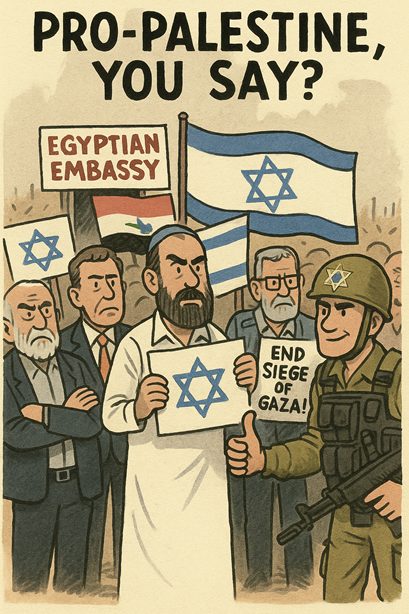
On social media, the world watched in shock. The hashtags #إخوان_خائنون (#MuslimBrotherhoodTraitors) and #الإخوان_عملاء_إسرائيل (#BrotherhoodAgentsOfIsrael) trended across Arab platforms as enraged users shared images of Brotherhood members standing under Israeli flags outside the Egyptian Embassy. To many, it was the ultimate exposure: decades of suspicion crystallized into a single, damning tableau of collaboration and duplicity.
This is not a one-off episode. The Brotherhood’s history of political bargaining with enemies of Egypt is well-documented. In 2012, when Mohamed Morsi—anointed president through the Brotherhood’s political machine—addressed Israel’s head of state as “my dear and great friend,” it foreshadowed the ideological flexibility of a group willing to barter away principles for power. The recent Tel Aviv protest is merely a continuation of this legacy: the exploitation of Palestinian suffering as a political currency, weaponized not against the occupier but against Egypt, the one actor that has consistently defended Palestinian existence.
Observers have rightly noted the absurdity of these protests being allowed to take place at all. Israel, notorious for crushing genuine demonstrations against its own policies—even those by Jewish activists—is suddenly a guardian of “freedom of protest” when the target is Egypt. Analysts point out that this is not coincidence but convenience: a political synergy between an occupier seeking to deflect blame for its genocidal campaign and a Brotherhood faction desperate to claw its way back into relevance after being rejected by Egyptians and discredited across the Arab world.
The protest in Tel Aviv, reportedly numbering only a few hundred participants, could not have occurred without explicit permission from Israeli authorities. Yet, while Israeli police were quick to approve a rally defaming Egypt, they continue to violently suppress protests against Netanyahu’s war policies, against settler violence, against home demolitions in the West Bank. This selective tolerance reveals the underlying truth: for Israel, the Brotherhood’s spectacle is useful, a diversionary narrative that paints Egypt as complicit in Gaza’s suffering, obscuring Israel’s stranglehold on the crossings and its deliberate blockade of humanitarian aid.
Much of the Brotherhood’s propaganda centers on the false claim that Egypt has “closed” the Rafah crossing, choking Gaza’s access to aid. The facts tell a different story. From the first day of the war, Egypt has kept its side of Rafah open, preparing convoys of humanitarian supplies on an unprecedented scale. The bottleneck lies not in Cairo but in Gaza’s northern gates, where Israeli forces decide, arbitrarily and punitively, which trucks pass and which are turned back.
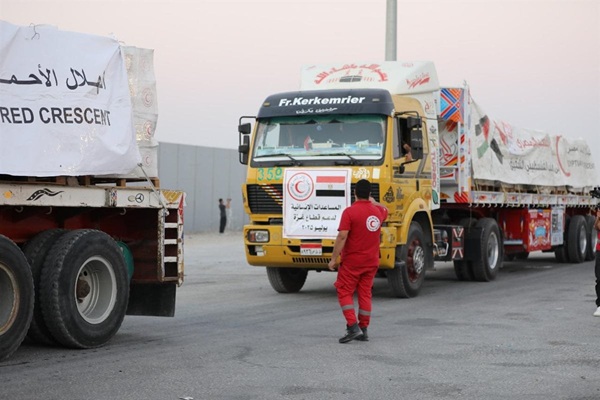
Egypt’s coordination with international agencies has been relentless, and no country has done more to push aid into Gaza under fire. Yet, the Brotherhood narrative deliberately ignores this truth, choosing instead to demonize Egypt. It is not an act of solidarity but a political dagger aimed at fracturing Arab unity, weakening Egypt’s regional standing, and providing cover for Israel’s strategy of deflection.
The ultimate danger of these manufactured protests lies not in their small numbers but in their intent. They are part of a larger strategy: to erode confidence in Egypt’s leadership, to cast doubt on its historic role as the Arab world’s shield against Israeli aggression, and to sow division among Palestinians and their closest ally. This is political warfare, waged not with tanks but with slogans, hashtags, and staged performances under the enemy’s flag.
Egypt, for its part, has faced such plots before. It has buried the Brotherhood’s ambitions within its own borders, stripped them of political legitimacy, and exposed their collusion with hostile forces. Now, as the group masquerades under the guise of “resistance” in Tel Aviv, Egyptians and Arabs at large can see the mask fully slip. What remains is the raw image of betrayal: Brotherhood members huddled under Israeli flags, protected by Israeli police, screaming not at the occupier but at the liberator, the mediator, the nation that has done more for Palestine than any other.
In the end, the Tel Aviv protests will not rewrite history. They will not erase the graves of Egyptian soldiers who fell defending Palestinian soil. They will not undo the thousands of aid convoys Egypt has dispatched, nor the international diplomacy it has spearheaded, nor its uncompromising rejection of forced displacement plans.
But they serve as a stark reminder of the moral bankruptcy of a movement that thrives on chaos, deception, and betrayal. The Muslim Brotherhood’s alignment with Israeli interests is no longer speculation—it is spectacle, broadcast to the world in full color. And yet, as Egyptians know, as Palestinians themselves acknowledge, such conspiracies cannot break the bond between Egypt and Palestine.
Egypt’s role is not born of political opportunism; it is born of history, blood, sacrifice, and principle. It is unshaken by slander, untouched by treachery, and unbroken by orchestrated plots. Long after the echoes of this manufactured protest fade, Egypt will remain what it has always been: the cornerstone of Arab defense, the guardian of Palestine’s cause, and the unwavering voice against occupation and injustice—no matter who stands under foreign flags to defame it.

Be Social




Comments
Leave a Comment