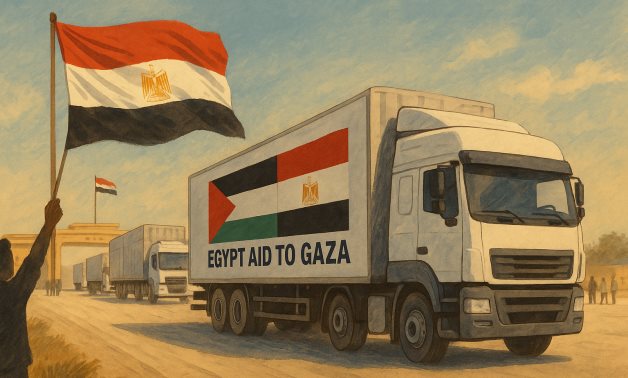
An Egyptian aid convoy crosses into Gaza through the Rafah border, delivering critical supplies amid ongoing humanitarian crisis - Illustrated by Egypt Today
CAIRO - 25 JULY 2025: In a region fraught with volatility and shifting alliances, Egypt has remained a constant pillar of support for the Palestinian cause. For decades, Cairo’s position has been firmly grounded in historical responsibility, national interest, and moral obligation. Today, as Gaza faces one of the worst humanitarian catastrophes in modern history, Egypt has emerged not only as a mediator in diplomacy but also as the region’s most reliable conduit for life-saving aid.
The war in Gaza, now nearing its first anniversary, has devastated the enclave. Infrastructure is in ruins, hundreds of thousands have been displaced, and famine looms over an already besieged population. In this moment of unparalleled suffering, Egypt has once again assumed its central role—delivering humanitarian assistance, facilitating ceasefire talks, and insisting on the sanctity of Palestinian land and identity.
AID DELIVERY AT UNPRECEDENTED SCALE
Since the early days of the war, Egypt has mobilized on multiple fronts. The Egyptian Red Crescent, operating under the supervision of the presidency, has coordinated the largest relief effort to Gaza since the blockade began. More than 50,000 tonnes of aid—including food, medical supplies, fuel, and shelter materials—have entered the Strip through the Rafah crossing.
“From day one, the Egyptian state has pursued many political and diplomatic paths to deliver medical and food aid to our Palestinian brothers,” said MP Ahmed Abdel-Gawad, Deputy President of the Mostaqbal Watan Party.
The scale of support has not gone unnoticed.
“It is enough to say that the largest country that provided humanitarian aid to the Palestinian people—both government and people—was Egypt,” declared Farid Zahran, President of the Egyptian Social Democratic Party.
Egypt has gone further than emergency relief. It has pushed for a comprehensive reconstruction framework—one that emphasizes local governance, avoids displacement, and rejects foreign-imposed blueprints that undermine Palestinian sovereignty. Cairo’s proposed multibillion-dollar reconstruction plan, unveiled at the Arab League summit earlier this year, underscores Egypt’s long-term commitment to rebuilding Gaza without compromising the identity of its people.
“Egyptian humanitarian aid is almost the dominant share of the assistance provided to the Palestinian people,” said Dr. Effat El-Sadat, President of the Sadat Democratic Party. “I don’t think anyone can ever question Egypt’s role or its leadership.”
PRINCIPLED POLITICAL STANCE
Egypt’s support for the Palestinian cause extends far beyond material aid. It is rooted in a national consensus that transcends party lines. Politicians, civil society leaders, and public intellectuals have repeatedly affirmed Egypt’s rejection of any form of displacement or normalization of occupation.
“This reaffirms Egypt’s steadfast position and principles regarding the Palestinian cause. We affirm Egypt’s support for the Palestinian people,” said MP Tarek Radwan, Chairman of the Human Rights Committee in the House of Representatives.
“Clearly, the Palestinian cause is the cause of the Egyptian people. It’s one cause. It’s a cause of humanity, a cause of historical rights, a cause of freedom,” stated MP Abdel Moneim Imam, President of the Justice Party. “Therefore, Egypt’s position is always an honorable one—always aligned with humanity, humanitarian standards, and justice.”
That alignment is echoed in the cultural and moral discourse of Egypt’s public sphere.
“Egypt has always stood behind the cause, behind the Palestinians—supporting their resilience and their ability to endure,” wrote veteran journalist Hamdy Rizk.
Even within the halls of academia and historical institutions, the message is consistent.
“What matters is that aid continues for the people of Gaza after the war, and the importance of rebuilding Gaza,” emphasized Dr. Ahmed Zayed, Director of the Bibliotheca Alexandrina.
A BURDEN BORNE WITH PRIDE
Providing such large-scale humanitarian assistance is no small feat. Egypt has borne immense logistical, financial, and political costs to maintain its role as the principal gateway for aid into Gaza. Security risks in North Sinai, pressure from international actors, and economic constraints have made the mission increasingly complex.
Yet Egypt has not wavered.
“Massive support, standing by the Palestinians, and the reconstruction of Gaza,” is how Major General Tarek Nasr, Secretary-General of the Homeland Protectors Party, described the effort.
“Egypt stands tall and steadfast,” said Gouda Abdel-Khalek, Member of the Board of Trustees of the National Dialogue. “It’s a difficult and undoubtedly costly position—but I believe history will clearly value this stance.”
That sentiment is echoed across Egypt’s political landscape.
“Yes to providing aid. Yes to everything we can offer our Palestinian brothers,” affirmed Tayseer Mattar, President of the Will of a Generation Party. “I want to say that Egypt’s role has been clear from the very first moment.”
“We must all stand together in solidarity with the state, without hesitation. We should have no fear—Egypt is truly protected,” said Moussa Mostafa Moussa, President of the El-Ghad Party.
A POSITION BEYOND POLITICS
As the war drags on and the humanitarian toll deepens, Egypt’s role remains indispensable. Its strategy, unlike many regional or international actors, is not based on shifting allegiances or tactical interests—it is built on principle.
“We reject the injustice, aggression, and oppression faced by the Palestinian people,” stated MP Abdel Hadi El-Qasabi, Deputy President of the Mostaqbal Watan Party.
Across political affiliations, the message is uniform: Egypt will not be a bystander. It will act. It will lead. And it will do so guided by its long-standing belief in Palestinian self-determination and dignity.
LOOKING FORWARD
With ceasefire negotiations gaining traction and international focus on post-war reconstruction, Egypt’s role will only grow in importance. Whether through rebuilding Gaza’s hospitals and homes, coordinating border logistics, or ensuring political unity among Palestinian factions, Cairo remains central to any meaningful path forward.
In a world increasingly shaped by polarization and geopolitical short-termism, Egypt’s conduct offers a rare example of consistency—and of moral clarity.
History may well record this moment not only as a test of global conscience but also as a reaffirmation of Egypt’s enduring commitment to justice, dignity, and the right of a people to live free.









Comments
Leave a Comment