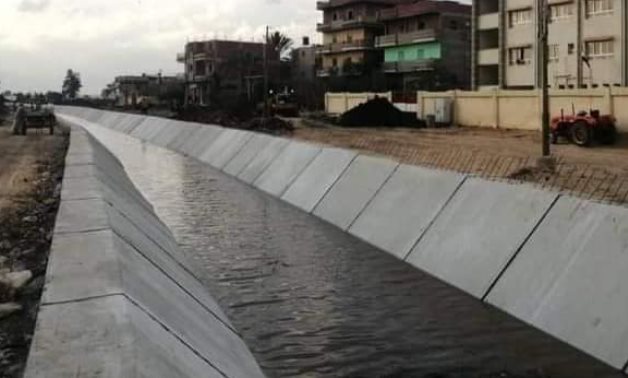
File- Egypt has completed the lining of 3,913 kilometers of irrigation canals nationwide- press photo




CAIRO – 11 July 2025: Minister of Water Resources and Irrigation Hani Sewilam stressed the urgent need to update the Egyptian Code for Irrigation and Drainage in light of significant developments in the water sector and the growing challenges it has faced in recent years.
He noted that his ministry has updated the National Water Resources and Irrigation Plan to keep pace with recent developments, stressing the critical need to revise the code in accordance with the core principles of second-generation irrigation systems (2.0).
These remarks were made during the minister’s address at the workshop titled "Preparatory Steps for Updating the Egyptian Code for Irrigation and Drainage", held at premises of the National Water Research Center (NWRC) in Qanater El Khairiya.
The event was attended by senior officials from the Irrigation Ministry, as well as members of specialized committees representing universities and research institutions.
Sewilam highlighted several pivotal developments in the water management landscape, most notably the growing reliance on treated agricultural drainage water and the anticipated need for desalination to support high-yield food production in the future.
He stressed the importance of drawing on successful desalination experiences from countries such as Morocco, Spain, Australia, and Malta, highlighting the need to develop highly skilled personnel in both water treatment and desalination technologies.
He commended the Ministry of Irrigation and the NWRC for their cadre of skilled engineers and researchers, who are well-prepared to contribute constructive proposals toward the code’s revision.
He instructed all departments, authorities, sectors, and affiliated research institutes within the ministry to actively participate in the update process, contributing their respective expertise to the development of a well-structured preliminary draft.
He further emphasized that the key themes to be incorporated into the updated code must be firmly rooted in applied research that has demonstrated successful implementation in real-world settings.
This includes the use of environmentally sustainable natural materials for coastal protection, as well as the integration of key components, such as water governance, the formation of water user associations, and the sustainable management of groundwater resources.
Moreover, the code must address sustainability across environmental, economic, and social dimensions in all water-related projects, and incorporate climate change adaptation, particularly in the design of flood protection and coastal defense infrastructure, by enhancing their capacity and resilience.
He stressed the necessity of training the ministry’s engineers and staff to gain a thorough understanding of the updated code and develop proficiency in advanced technological tools relevant to the water sector.
This training involves water treatment and desalination technologies, the utilization of satellite imagery for identifying canal clearing sites, the deployment of drone technology (DT) for monitoring violations, the use of tablet devices for recording spatial data, and the upgrading of canal clearing equipment to maintain optimal water flow cross-sections.
He underscored the importance of adopting these technologies to enhance water management efficiency and address the challenge of human resource shortages, particularly among engineers and technicians.
The minister also reviewed recent progress, notably the development of a comprehensive database to monitor canal clearing operations and assess contractor performance, which will be integrated with satellite-based monitoring systems.
Concrete measures have been implemented to enable irrigation departments to apply water rotation practices on the ground, notably through the rehabilitation of canal head gates, he said.
He also highlighted significant progress in the ministry’s organizational and institutional development, including improvements in employee compensation and benefits, enhancements to healthcare and social services, and the establishment of a comprehensive performance evaluation system covering all functional levels.
This system will serve as a foundation for promotion decisions and the allocation of bonuses and performance-based incentives.

Be Social




Comments
Leave a Comment