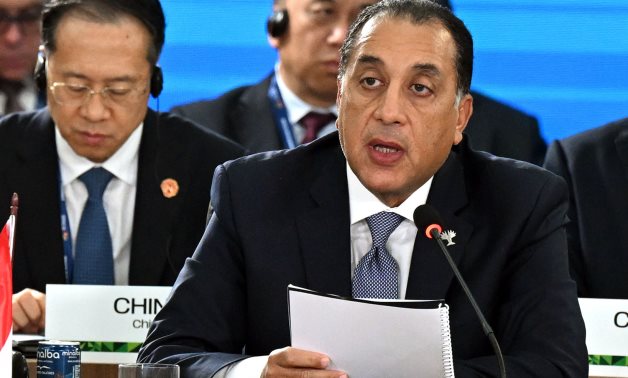
Prime Minister Mostafa Madbouly delivered Egypt’s address during a session of the 17th BRICS Summit, held in Rio de Janeiro, Brazil on July 7, 2025




CAIRO – 7 July 2025: Speaking on behalf of President Abdel Fattah El-Sisi, Prime Minister Mostafa Madbouly delivered Egypt’s address during the third and final session of the 17th BRICS Summit, held in Rio de Janeiro, Brazil, under the theme "Environment, COP30, and Global Health."
Madbouly reaffirmed Egypt’s commitment to the goals of the United Nations Framework Convention on Climate Change (UNFCCC) and the Paris Agreement, underscoring the foundational Rio Principles, especially the principle of common but differentiated responsibilities.
He added: "However, we are concerned about the clear lack of commitment by developed countries to provide the necessary financing and other implementation mechanisms to achieve the level of ambition contained in the Nationally Determined Contributions (NDCs) submitted by our developing countries."
He noted that developing countries require approximately $5.9 trillion by 2030 to meet their NDCs. However, the annual $100 billion pledge by developed nations has still not been fulfilled. Additionally, he highlighted that adaptation costs alone range between $140 and $300 billion annually for developing countries.
Dr. Mostafa Madbouly explained that the Egyptian Presidency of COP27 has made every effort to achieve tangible and effective progress in various areas of climate action, particularly with regard to the "just transition," the pivotal role of multilateral development banks in financing climate action, and, most importantly, the establishment of the Loss and Damage Fund.
Dr. Mostafa Madbouly emphasized that providing the necessary means of implementation for developing countries, particularly concessional financing and technology transfer, is a cornerstone of joint international efforts on this important issue.
He said, "We are confident in the ability of Brazilian diplomacy to lead the work at the COP30, prioritizing the needs of developing countries, which should not be forced to choose between climate action and their efforts to eradicate poverty and achieve sustainable development."
Regarding the healthcare issue, Madbouly noted that over the past years, Egypt has paid great attention to developing its healthcare system and medical services. This has been demonstrated by increasing national spending on the health sector, formulating a comprehensive vision to improve healthcare efficiency, developing health infrastructure, and expanding the implementation of the comprehensive health insurance system.
He continued: "We have also launched a number of initiatives targeting all segments of society, including women and children, most notably the presidential "Decent Life" and "100 Million Health" initiatives, in addition to providing treatment to 4.6 million citizens as part of our initiative to eliminate hepatitis C and detect non-communicable diseases."
The Prime Minister explained that the health sector is one of the most important sectors through which countries can enhance cooperation and coordinate positions in various multilateral forums, saying: "We must build on the historic adoption of the United Nations Convention on the Prevention and Control of Epidemics, while benefiting from the lessons learned during the COVID-19 pandemic, particularly through capacity building and technology transfer to developing countries, and emphasizing the pivotal role of the World Health Organization in this regard."
He added: "We can also strengthen our cooperation, particularly in implementing joint research and innovation programs related to vaccine development and production, and addressing non-communicable diseases. We also recognize the important role of the private sector in our joint efforts and in investing in our countries' health systems. We emphasize the important role of the BRICS Vaccine Research and Development Center in strengthening our joint efforts."
Prime Minister Madbouly concluded by reaffirming Egypt’s readiness to deepen cooperation with BRICS nations across environmental and health fronts, saying:

Be Social




Comments
Leave a Comment