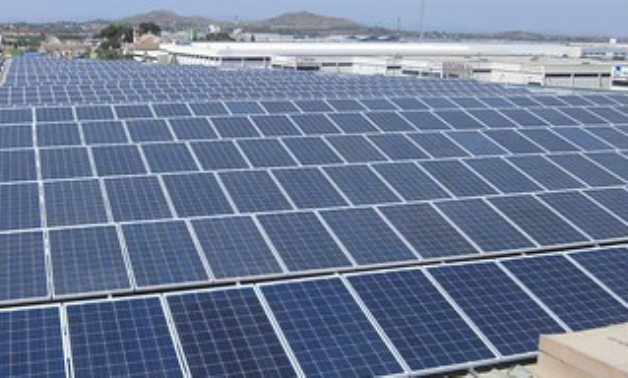
Solar panel- CC via Flickr/PANEL SOLAR




CAIRO — 8 June 2026: Egyptian Prime Minister Mostafa Madbouly has directed the government to accelerate the finalization of a national initiative aimed at installing solar panels on the rooftops of houses and factories, part of a broader push to expand the country's renewable energy capacity.
During a meeting with relevant ministers, Madbouly reviewed the progress of the initiative, titled "Encouraging the Installation of Solar Panels on the Rooftops of Houses and Factories." He emphasized the need to widely optimize solar power usage and instructed officials to draft a comprehensive plan featuring financial incentives to encourage public and industrial participation.
The meeting was attended by Minister of Electricity and Renewable Energy Mahmoud Esmat, Minister of Industry Khaled Hashem, and several senior officials from relevant authorities.
Minister Esmat delivered a presentation detailing the implementation mechanisms of the initiative. He noted that the ministry is currently coordinating with financing institutions and the Federation of Egyptian Industries to provide suitable funding options and incentives. These measures aim to encourage factories to adopt solar energy, ultimately reducing pressure on the national electricity grid.
In previous comments to Youm7 on May 18, 2026, Mansour Abdel Ghani, Spokesman for the Ministry of Electricity and Renewable Energy, revealed that as part of efforts to scale up renewable energy adoption, citizens will be exempted from any restrictive conditions regarding the installation of rooftop solar panels.
This initiative aligns with directives from President Abdel Fattah El-Sisi to expand the country's reliance on solar energy by accelerating renewable energy projects, particularly amid an ongoing power crisis linked to regional military conflicts. In a cabinet meeting last April, Madbouly reviewed presidential directives focusing on adding targeted capacities from wind, solar, and battery storage systems to the national grid. He emphasized that these efforts are central to Egypt’s broader strategy to diversify energy sources, reduce dependence on fossil fuels, and transition toward a sustainable energy mix under the National Energy Strategy.
Egypt is uniquely positioned as one of the most favorable locations globally for solar power generation, boasting some of the highest sunshine rates in the world. According to the Central Agency for Public Mobilization and Statistics (CAPMAS), the country receives an annual average of 2,900 to 3,750 hours of sunshine—equivalent to roughly 9 to 11 hours per day. These figures rise even higher in Upper Egypt and desert regions like Aswan, where annual sunshine exceeds 4,000 hours, making them ideal hubs for solar production.
Consequently, the Aswan Governorate has emerged as a leading model for clean energy, hosting strategic projects such as the massive Benban Solar Park. The government is also actively developing new solar power stations in the Fares and Raqaba areas within the governorate.
Engineer Ibrahim Mahrous, a member of the Arab Council for New and Renewable Energy, told Youm7 that Egypt’s total production from renewable energy projects currently stands at approximately 9 gigawatts. This capacity is diversified across solar, wind, hydropower, and emerging nuclear projects, marking steady progress toward the nation's energy self-sufficiency goals.

Be Social




Comments
Leave a Comment